
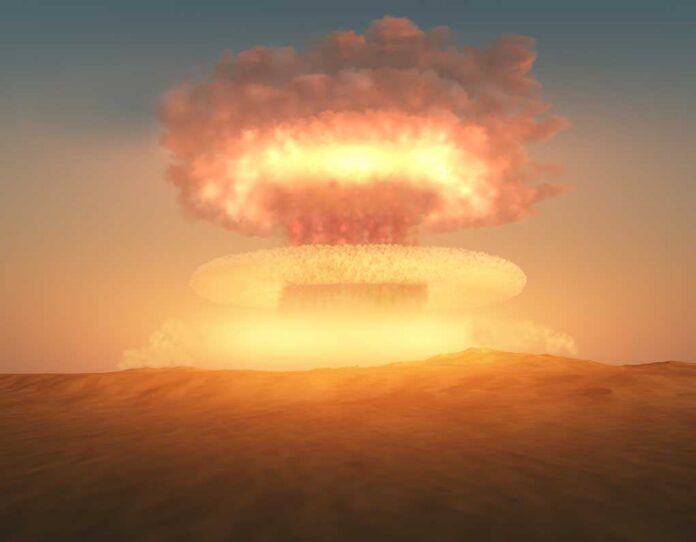
Britons are being told the first 10 minutes after a nuclear alert could decide who lives—yet the only “guaranteed” shelter many people can picture is a Cold War bunker built for government and broadcasters, not ordinary families.
Quick Take
- UK guidance emphasizes immediate shelter: get inside a solid building, stay put for 24–48 hours, and rely on official broadcasts for updates.
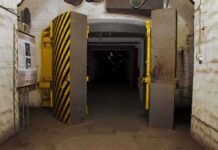
- A declassified Cold War-era bunker under Wood Norton Hall was designed to keep officials and BBC broadcasting running, highlighting continuity plans for elites.
- Risk maps consistently flag major cities and strategic military or intelligence sites as higher-risk areas in a nuclear scenario.
- Experts warn even “limited” nuclear use can spiral fast, making practical household planning more realistic than last-minute travel.
The 10-minute reality: shelter beats “getting out of town”
UK nuclear survival guidance is blunt: when the warning comes, the safest move is not driving across the country—it is getting indoors immediately, putting as much dense material between you and fallout as possible, and staying there. The protocol is summarized as “Go In, Stay In, Tune In.” It directs people to choose brick or concrete shelter, remain inside for at least 24 to 48 hours, and monitor updates via radio-style official messaging.
Safest position to get in if nuclear war hits UK as 10 minutes can 'save your life' https://t.co/U1Kw8NAxns
— Nicola Jordan (@NicolaJord76909) March 4, 2026
The logic is practical, not political. Fallout risk is highest shortly after a blast, and panic traffic can trap people in exposed vehicles or on open roads. Guidance also emphasizes using an interior, lower-level room away from exterior walls and rooflines—what some preparedness experts call a “fallout room.” The core idea is simple: time and shielding reduce exposure, so the early minutes should be spent improving protection, not searching for perfect answers.
Cold War bunkers show who governments planned to protect first
Public attention keeps circling back to one striking example of Cold War planning: a bunker beneath Wood Norton Hall in Evesham, Worcestershire. Declassified documents and subsequent reporting describe it as a deep, multi-level facility originally linked to the BBC’s resilience planning—built so officials and broadcasters could keep communications running during a nuclear crisis. Reports describe capacity for roughly 600 people, reinforcing that such sites were designed for continuity of state functions, not mass public shelter.
Wood Norton Hall is now a commercial hotel, and reporting indicates the bunker remains intact but is not routinely used for government purposes. The public-facing problem is obvious: the existence of hardened facilities can create a false sense that “there’s a place to go,” when access protocols are not public and travel may be dangerous or impossible. The more realistic takeaway for families is to harden where they are—identify shelter, stock basic supplies, and plan communication—because most people will not reach specialized infrastructure.
Where risk concentrates: cities, bases, and national-security nodes
Location still matters, and the research consistently points to the same high-risk categories: major population centers and strategic sites. Reporting highlights large cities such as London, Birmingham, Manchester, and Edinburgh as obvious targets due to population and national importance. It also flags naval bases and military facilities—including Faslane (HMNB Clyde), Portsmouth, and Devonport—along with air bases associated with U.S. personnel such as RAF Lakenheath and RAF Mildenhall, and intelligence hubs like GCHQ Cheltenham.
By contrast, analysis in the research points to lower-risk areas in more rural regions, including parts of Scotland and Wales (with clear exceptions around key bases), plus areas such as Snowdonia, the Cambrian Mountains, and parts of Cornwall and Devon away from major naval infrastructure. None of this turns any location into a “safe zone,” but it does help people think clearly about likely risk concentration. The responsible move is to use that information for planning, not for frantic, last-minute relocation.
Escalation risk and the limits of “common-sense” reassurance
Think-tank analysis cited in the research warns that even a single, relatively low-yield nuclear detonation could produce uncontrollable escalation because leaders cannot reliably contain events once thresholds are crossed. That caution matters because it pushes against the comforting idea that nuclear war would stay “limited” or neatly managed. It also puts more weight on household-level readiness: if escalation is unpredictable, families need a plan that works without perfect information and without immediate government rescue.
UK leadership rhetoric has also shifted toward openly preparing for wartime threats, according to reporting cited in the research. That doesn’t guarantee conflict, but it does make civil-defense basics worth revisiting—especially after decades when many Western governments treated preparedness as unfashionable. For conservatives watching global instability, the lesson is straightforward: self-reliance and clear-headed planning beat bureaucratic complacency. The guidance available to the public is imperfect, but it is still actionable—if people treat the first 10 minutes as a shelter-and-shield problem, not a politics debate.
Sources:
The secret UK location that would be one of the world’s safest places if WW3 broke out
WW3 survival guide: people told golden rule, safest locations
Stepping back from the brink: how the UK could help lead the world away from the nuclear precipice
Britain planned for nuclear war — then abandoned home defence
WW3 survival guide: people told golden rule, safest locations