
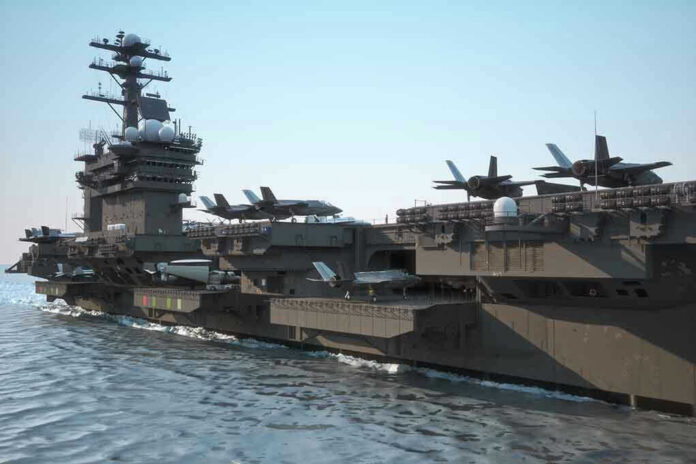
America’s sole nuclear aircraft carrier refueling shipyard faces catastrophic delays, leaving the U.S. Navy vulnerable to global threats just as President Trump works to rebuild military strength.
Story Snapshot
- Newport News Shipbuilding, the only U.S. facility for nuclear carrier refueling, is 14 months behind on USS John C. Stennis overhaul.
- $483 million cost overrun from steam turbine damage, labor shortages, and supply chain issues risks Navy’s 11-carrier mandate.
- Upcoming USS Harry S. Truman refit overlaps, creating a dangerous “carrier crunch” amid rising tensions with adversaries.
- Single-shipyard monopoly exposes systemic weaknesses from years of underinvestment and post-COVID disruptions.
- President Trump’s administration must prioritize industrial base expansion to restore naval dominance and protect American interests.
Stennis Overhaul Plagued by Delays
USS John C. Stennis (CVN-74), commissioned in December 1995, entered Refueling and Complex Overhaul (RCOH) in May 2021 under a $3 billion contract awarded to Newport News Shipbuilding in February 2021. The carrier undocked from dry dock on April 8, marking over 65% completion and entry into outfitting and testing phases. Original completion targeted August 2025, but engineering failures including a damaged steam turbine pushed delivery to October 2026—a 14-month delay adding $483 million in overruns. Labor shortages and supply chain disruptions exacerbated these setbacks, straining the sole facility capable of this midlife refueling process.
Single Shipyard Creates Strategic Bottleneck
Newport News Shipbuilding, part of Huntington Ingalls Industries, holds a monopoly on nuclear carrier RCOH, refueling reactors, upgrading propulsion, combat systems, hulls, and electronics to extend 50-year service lives. All 10 Nimitz-class carriers originated there, facing competing demands from Ford-class builds and Columbia-class submarines. This reliance on one yard creates cascading delays, threatening the Navy’s statutory 11-carrier requirement for global power projection through carrier strike groups. Defense analyst Jack Buckby warns of an “aircraft carrier crunch” as Stennis delays overlap with USS Harry S. Truman (CVN-75) RCOH scheduled for 2026 start.
Impacts Threaten Naval Readiness
Short-term, overlapping overhauls reduce available carriers below 11, forcing extensions like USS Gerald R. Ford’s deployments and straining operational rotations. Long-term, this erodes U.S. naval superiority amid peer competition from China and others, perpetuating industrial base fragility. Economic fallout includes budget strains from overruns and workforce crises in Virginia communities dependent on the yard. Navy officials like Capt. Scott Johnson acknowledge RCOH’s demanding nature, enhancing every system but challenging teams. These vulnerabilities demand urgent action to expand capacity and secure America’s maritime edge.
Precedents like USS George Washington (CVN-73) RCOH success through integrated teams offer hope, but Stennis’s unique turbine failure and post-COVID issues highlight deeper problems. USS Abraham Lincoln (CVN-72) recently advanced to outfitting, underscoring yard pressures. President Trump’s focus on military rebuilding provides a critical window to address this monopoly, invest in shipbuilding infrastructure, and prevent adversaries from exploiting U.S. weaknesses. Failure risks American families and freedoms reliant on unmatched sea power.
https://twitter.com/19_forty_five/status/2035049513694458265
Sources:
Refueling Complex Overhaul Completed on USS George Washington (CVN 73)
Overhaul of aircraft carrier enters new phase at Newport News Shipbuilding
USS John C. Stennis (CVN 74) Leaves Dry Dock, Begins Second Phase of Refueling and Complex Overhaul
Navy Awards $3B to Newport News Shipbuilding for USS John C. Stennis Refueling
USS George Washington (CVN-73) RCOH Contract