
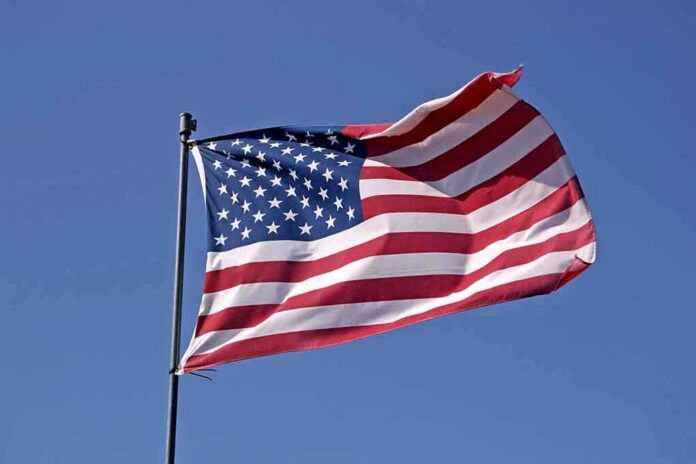
After seven years of hostility and a region rocked by dictatorship, the American flag is flying again over the U.S. Embassy in Caracas—signaling a hard reset in U.S.-Venezuela relations with major energy stakes.
Story Snapshot
- Embassy staff raised the U.S. flag in Caracas on March 14, 2026, for the first time since relations broke down in 2019.
- The flag was hoisted at the same time it was lowered seven years earlier, underscoring the symbolic nature of the moment.
- The diplomatic thaw followed the January 2026 U.S. military operation that captured Nicolas Maduro, who was taken to New York to face drug trafficking charges.
- The Trump administration and Venezuela’s interim government have reopened relations and signed new energy and mining agreements tied to private investment.
Flag-Raising Marks a Precise, High-Visibility Diplomatic Reopening
U.S. embassy staff in Caracas raised the American flag on March 14, 2026, marking the first such ceremony since Venezuela severed diplomatic relations with Washington in March 2019. The timing was deliberate: the flag was hoisted at the exact time it had been lowered seven years earlier, a detail that highlights how both governments want the public to read this as a formal turning of the page. U.S. Charge d’Affaires Laura Dogu led the event.
Laura Dogu framed the moment as the start of a new phase, saying a “new era” had begun and signaling forward momentum. For Americans who are tired of foreign-policy symbolism with no results, this ceremony matters because it is tied to concrete changes already underway: a reopened diplomatic channel, a shifting political landscape in Caracas, and early economic moves aimed at energy and mining. The event is less about pageantry than about leverage and access.
How the 2019 Break Happened—and Why It Matters Now
U.S.-Venezuela relations collapsed after Nicolas Maduro’s disputed 2018 re-election, which triggered international controversy over democratic legitimacy. The United States refused to recognize Maduro’s government, and Venezuela responded by severing diplomatic relations in March 2019. That break effectively closed the door on regular embassy operations and froze many forms of bilateral engagement. It also left Americans with fewer tools on the ground to monitor conditions, protect interests, and counter regional threats.
The 2019 rupture also intersected with economic and strategic realities. Venezuela holds vast oil reserves, but the breakdown in relations and subsequent sanctions environment limited how American and other multinational companies could operate. The result was a long stretch where U.S. influence in Caracas was constrained, while Venezuelans faced ongoing instability. The new flag-raising is being presented as proof that the diplomatic freeze is ending and that both sides see a reason to rebuild formal channels.
Maduro’s Capture Reshaped Power—and Created Negotiating Space
The immediate catalyst for the diplomatic shift was the January 2026 U.S. military operation that captured Maduro and flew him to New York to face drug trafficking charges. With Maduro removed from power, the key obstacle to normalization was effectively taken off the board, changing the internal power dynamics and the external negotiating environment. The research identifies this event as a watershed moment that fundamentally altered Venezuela’s political landscape and opened the door to renewed talks.
Energy and Mining Deals Put Economics at the Center of the “New Era”
After the political transition began, Washington and Caracas moved quickly beyond symbolism. The Trump administration signed new energy and mining agreements with Venezuela’s interim leadership aimed at opening these sectors to private investment. Venezuela’s interim president, Delcy Rodriguez, has pushed the United States to fully lift sanctions, while some restrictions have already been eased since January 2026 to allow multinational companies limited licenses to resume operations.
This is where conservatives should focus on the measurable outcomes rather than the slogans. The research supports that the U.S. approach is explicitly tied to strategic interests—energy access and investment terms—while the pace and scope of sanctions relief remain a live negotiation. With only one primary news source provided, key details are still limited on enforcement mechanisms, the durability of Venezuela’s interim governance, and how any new revenue will be managed on the ground.
Sources:
US-Venezuela relations ease after Maduro capture: US flag raised at embassy in Venezuela