

Iran’s claimed missile shot at a U.S. supercarrier is colliding with President Trump’s decision to mass enough naval airpower to turn the Persian Gulf into a round-the-clock strike zone.
Quick Take
- U.S. forces are operating in a fast-escalating maritime fight with Iran as Tehran claims a coast-to-sea missile attack near USS Abraham Lincoln.
- The Navy’s surge could place two carrier strike groups near Iran, with preparations reported for a third carrier to deploy.
- Carrier air wings and Tomahawk-capable escorts give Washington sustained strike capacity while defending shipping lanes and regional bases.
- Iran’s retaliation strategy relies on missiles, drones, and pressure on the Strait of Hormuz, a critical oil chokepoint tied to price spikes.
Iran’s Missile Claim Raises the Stakes for U.S. Naval Power
Iranian state-linked messaging claimed a coast-to-sea missile was fired at USS Abraham Lincoln on March 12, 2026, framing the attack as retaliation tied to the reported sinking of the Iranian frigate IRIS Dena. U.S. confirmation of a direct hit has not been established in the provided reporting, but the episode underscores how quickly naval posturing can become active combat when missiles, drones, and swarming tactics enter the picture.
U.S. deployments described across the research place Lincoln operating in the Arabian Sea while USS Gerald R. Ford moved through the Suez Canal into the Red Sea earlier in March. The operational geography matters because it spreads U.S. air and missile defense coverage across multiple waterways while keeping striking distance options open. That layered posture is designed to protect American personnel and allies, and to reduce Iran’s ability to gamble on a single, decisive disruption.
Three-Carrier “Floating Air Force” Concept Drives Deterrence and Strike Capacity
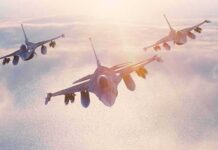
Reporting cited in the research argues that up to three carrier strike groups could be positioned to generate sustained, high-tempo air operations, with a combined carrier-based aircraft count that could exceed 200 depending on loadouts and embarked squadrons. The core military logic is simple: carriers function as mobile airbases that can reposition, sustain sortie generation, and concentrate firepower without relying exclusively on fixed regional runways that Iran can target.
The same analysis highlights the surge potential of carrier aviation—often described as 100-plus daily sorties per carrier in a “surge” posture—paired with escort ships that bring integrated air and missile defense plus long-range strike options. In practical terms, this posture gives U.S. leaders multiple rungs on the escalation ladder, from defensive interceptions to precision strikes against military infrastructure, without immediately committing ground forces or expanding the footprint ashore.
Regional Base Attacks Show Why Limited Government Still Needs Real Defense
Business and military reporting referenced in the research describes U.S. air defenses repeatedly engaging Iranian missiles and drones aimed at American positions and partner territory across the Gulf region, including Qatar, Bahrain, Kuwait, and the UAE. That reality puts a premium on capability over slogans: when incoming threats are measured in seconds, layered defenses and nearby aviation are what protect Americans, not press releases or “de-escalation” talking points.
The research also notes U.S. strikes hitting Iranian military assets, including legacy aircraft, amid what President Trump described as “major combat operations.” The details of specific battlefield outcomes remain fluid in the sources, but the broad pattern is clear: Iran is attempting to impose costs through asymmetric attacks, while U.S. forces are responding with a mix of ship-launched weapons, airpower, and defensive intercepts intended to blunt follow-on salvos.
The Strait of Hormuz, Oil Prices, and the Cost of Letting Tehran Dictate Terms
Military and news accounts in the research emphasize the Strait of Hormuz as the pressure point Tehran repeatedly threatens—an energy chokepoint commonly described as carrying roughly one-fifth of global oil flows. The reported oil surge above $100 amid tanker disruptions is the kind of kitchen-table consequence Americans recognize immediately. When shipping lanes become a battlefield, families feel it through higher fuel and transport costs, even if the fighting is thousands of miles away.
Supercarrier Surge: Why a Fleet of U.S. Navy Aircraft Carriers Could Soon Be Striking Iranhttps://t.co/8jGFP4ONd0
— 19FortyFive (@19_forty_five) March 12, 2026
The available sources do not fully resolve key disputed claims, including Iran’s account of missile effectiveness near Lincoln and the precise chain of events surrounding IRIS Dena. What is well supported, however, is the broader escalation trajectory: multiple U.S. naval and air assets operating across the Red Sea and Arabian Sea, increased strike and defense activity, and an effort to deter Iran from turning maritime commerce into a hostage. For constitutional conservatives, the takeaway is straightforward: deterrence works best when it is credible, clearly communicated, and backed by overwhelming capability.
Sources:
us-forces-air-defense-battles-fight-with-iran-official-2026-2
what-firepower-could-three-u-s-aircraft-carrier-strike-groups-deliver-against-iran
us-military-assembles-largest-force-of-warships-aircraft-in-middle-east-in-decades
us-preparing-to-deploy-3rd-aircraft-carrier-to-region-for-strikes-on-iran