
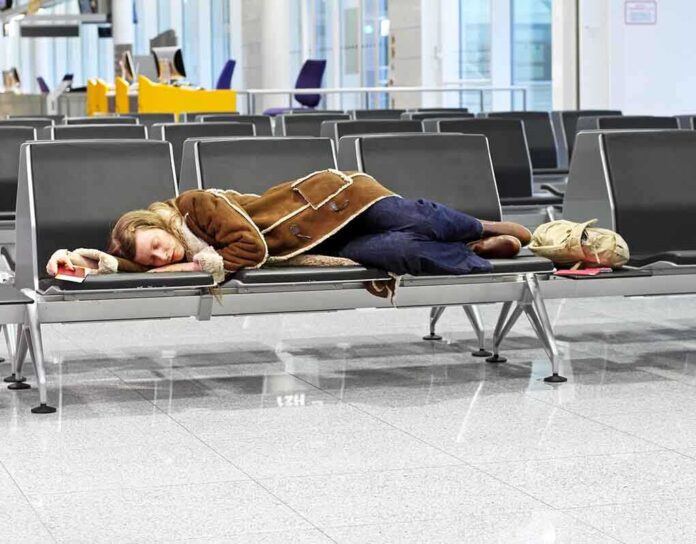
The US government shutdown is causing chaos in airports, leaving passengers stranded and frustrated.
Story Snapshot
- Government shutdown leads to unpaid essential staff and flight delays.
- Passengers are avoiding airports, impacting airlines and local economies.
- Prolonged shutdown poses risks to aviation safety and efficiency.
- Multiple sources confirm the severity of the disruptions.
Government Shutdown: The Immediate Impact on Air Travel
The shutdown that began on October 1, 2025, has thrown the U.S. aviation system into disarray. Essential staff like air traffic controllers and TSA officers are working without pay. This has led to severe staffing shortages and increased absenteeism, causing widespread flight delays and cancellations. The ripple effects are evident as passengers increasingly choose to avoid airports, fearing uncertainty and prolonged travel times.
Major airports including Denver, Newark, and Dallas have been the hardest hit. The situation is exacerbated by an existing shortage of 3,000 air traffic controllers even before the shutdown. The strain on the system is palpable, with some terminals temporarily closing due to insufficient staffing. The scenario is reminiscent of the 2018–2019 shutdown, though its impact is more severe due to compounded staffing issues.
Political Standoff and Its Consequences
The government shutdown is the result of a political deadlock over a massive $1.7 trillion budget. Disputes between President Donald Trump and congressional Democrats have left essential services in limbo. This political struggle has left essential aviation personnel working without pay, affecting their morale and increasing sick leave rates. The longer the shutdown persists, the more severe the consequences for air travelers and the broader economy.
Airlines are raising alarms about the potential for even more significant delays, urging Congress to resolve the funding impasse. The possibility of further disruptions looms large as airlines struggle to maintain operations and passenger confidence wanes. The aviation industry and its stakeholders are in a precarious position, with the shutdown threatening both immediate operational capacity and long-term public trust.
Economic and Social Repercussions
The economic impact of this shutdown extends beyond airports and airlines. Local economies dependent on air travel are experiencing a downturn as passengers avoid travel. The FAA’s ability to upgrade systems and conduct safety certifications is also compromised, potentially leading to long-term setbacks in aviation safety and efficiency. The broader economic implications include potential job losses and market instability if the shutdown continues.
Passengers, particularly those at major hubs and rural airports, are feeling the brunt of these delays. The reduced travel demand is evident as travelers seek alternative means or postpone trips altogether. The social fabric is strained as travelers and aviation workers alike face increased stress and uncertainty.
Expert Opinions and Industry Analysis
Industry experts voice concerns over the shutdown’s effects. Geoff Freeman of the US Travel Association highlights the mounting delays and cancellations as a critical issue. Similarly, aviation experts point to the pre-existing controller shortages, which have now been exacerbated by unpaid work. The consensus among stakeholders is clear: the shutdown is a significant threat to both the immediate and future stability of U.S. aviation.
Airline industry groups are lobbying for a swift resolution to restore funding and operational normalcy. Meanwhile, political leaders are caught in a blame game, with each side accusing the other of holding essential services hostage for political gain. The situation remains tense as the shutdown shows no signs of an imminent resolution.