

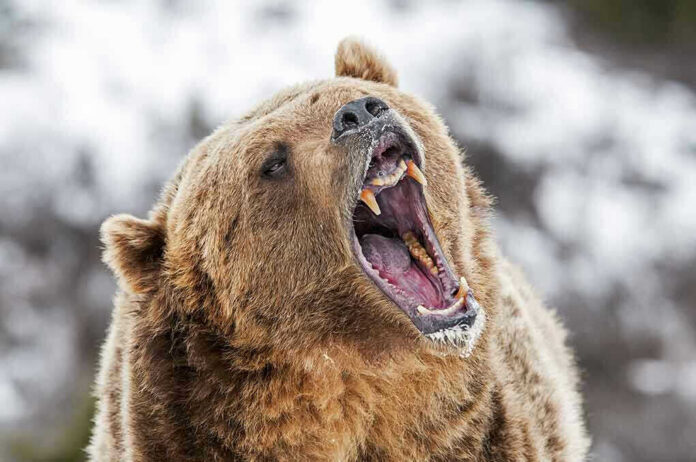
primechronicle.org — Two grizzlies barreled past stunned hikers on a narrow Glacier National Park trail, renewing a hard question: are current park rules enough to keep families safe in bear country?
Story Snapshot
- Video shows two grizzlies sprinting past hikers on a Glacier trail, a reminder that encounters can escalate without warning [7].
- Recent incidents include a suspected fatal bear attack and a separate injury where bear spray ended a charge, underscoring mixed outcomes [3].
- National Park Service records describe recurring “surprise encounters,” a category that shapes how officials explain risk [1].
- Glacier’s own 2025 report credits quick bear spray use for stopping a sow with cubs after contact injuries occurred [6].
What the viral Glacier trail video shows—and what it does not
Footage from Glacier National Park captures two young grizzly bears racing down a trail as hikers press to the side, creating a near-miss that could have turned deadly within seconds [7]. The short clip shows a classic surprise encounter where people and bears share the same tight corridor. The video does not reveal how far the hikers could see, whether they carried bear spray, or how much noise they made—details that decide whether a tense moment stays a story or becomes a tragedy [7].
Glacier’s history shows how fast these moments can break bad. Local reporting this month details a missing hiker believed to have been killed by a grizzly in the park, with rangers treating the case as a likely attack based on evidence found during the search [3]. Separate coverage identifies the victim and location, reinforcing that Glacier’s backcountry remains high-consequence terrain where a single mistake, or sheer bad luck, can be fatal [4].
Park records show patterns—and the limits of policy labels
National Park Service incident archives for Glacier National Park repeatedly classify conflicts as “surprise encounters,” “defensive behavior,” or “provocation,” categories that shape official messaging and subsequent restrictions [1]. The archive includes examples where hikers unintentionally surprised bears and were charged, along with cases tied to human choices like leaving trails to photograph animals [1]. These labels matter because they often determine whether officials emphasize human error, bear behavior, or randomness when briefing the public after an incident [1].
That framework meets real-world stakes. In August 2025, a Glacier news release described two hikers near Lake Janet who encountered a brown-colored bear with two cubs that charged from brush, making contact and injuring a woman before her partner deployed bear spray, which made the bear immediately flee [6]. A Flathead Valley outlet reported the same encounter, noting shoulder and arm injuries to the hiker and confirming the swift retreat after spray deployment [9]. Those facts align with long-standing advice: carry spray, stay in a group, and respond instantly [6][9].
Mixed lessons from recent outcomes: prevention, preparedness, and reality
Recent cases deliver a double message: preparation helps, but nature does not negotiate. The Lake Janet incident demonstrates that bear spray used promptly can end a charge, even after initial contact and injury [6]. The suspected fatal attack this spring shows that not every encounter ends that way, and that hikers can still die despite modern guidance and rapid ranger response [3]. Families planning Glacier trips should see both realities clearly before trading paved viewpoints for tight timber and blind corners [3][6].
For years, some visitors have triggered danger by crowding wildlife or leaving marked trails, while others have done nearly everything right and still faced charges at close range, according to National Park Service records [1]. The agency’s categorical approach helps explain causes, but it can also feel like post-incident sorting to those who want stronger front-end prevention, better trail advisories on active bear corridors, and clearer, louder education at trailheads when sows with cubs are ranging nearby [1].
Common-sense guardrails for families who refuse to cede the outdoors
Conservatives value self-reliance and responsible access to public lands. Glacier is not a zoo, and the country should not fence off wilderness because risk exists. The answer is practical freedom: carry bear spray where you can reach it, hike in groups, keep voices up in thick brush, honor closures, and turn around when sign, scat, or limited sightlines stack the odds. Those steps preserved life on Lake Janet; they cost nothing compared to a medevac or a family’s loss [6][9].
Two hikers are speaking out after they encountered a couple of grizzly bears in Montana's Glacier National Park this week. https://t.co/jkgvkBfrz0 pic.twitter.com/EtG87Qkchq
— ABC News (@ABC) May 28, 2026
Officials will continue to classify incidents and adjust closures, but personal readiness is the margin that matters most when two hundred yards of alpine trail becomes five seconds of decision. The Glacier video is a gift if we treat it as training: tight trails, fast bears, and zero time. Pack the spray, practice the draw, and walk with purpose. Freedom to roam remains intact when citizens shoulder the responsibility that keeps it that way [7].
Sources:
[1] YouTube – Hikers dodge charging grizzly bears at Glacier National Park. See the …
[3] Web – Backcountry Hikers Charged By Grizzly @ Yellowstone National Park
[4] Web – Missing hiker at Glacier National Park likely died from bear attack …
[6] YouTube – Grizzly Kills Hiker in Glacier National Park and Two …
[7] Web – Backcountry Hiker Injured by Bear in GNP – Glacier National Park …
[9] Web – Missing Hiker Found Dead in Glacier National Park Was Likely …
© primechronicle.org 2026. All rights reserved.