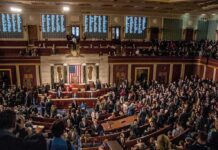


A pending Supreme Court decision could fundamentally reshape American democracy by allowing the Republican Party to gain up to 19 additional House seats through strategic redistricting maneuvers.
Story Snapshot
- Supreme Court ruling may enable GOP to redraw congressional districts for significant partisan advantage
- Potential gain of 19 House seats could cement Republican control and create one-party dominance
- Decision builds on previous rulings that limited federal court intervention in gerrymandering cases
- Stakes involve fundamental questions about democratic representation and electoral fairness
The Constitutional Crossroads
The Supreme Court stands poised to deliver a ruling that could dramatically alter the balance of power in Congress. At the heart of this case lies the fundamental tension between states’ constitutional authority to draw their own congressional districts and the federal government’s role in protecting voting rights. The justices must weigh decades of precedent against evolving interpretations of electoral law.
This decision emerges from a complex legal landscape shaped by landmark cases like Rucho v. Common Cause in 2019, which effectively removed federal courts from policing partisan gerrymandering. That ruling opened the door for states to pursue more aggressive redistricting strategies, setting the stage for today’s high-stakes confrontation.
The Mechanics of Political Power
The potential addition of 19 Republican House seats would represent more than just numbers on a legislative scorecard. Such a shift would fundamentally alter the dynamics of American governance, potentially creating a scenario where meaningful legislative opposition becomes virtually impossible. Republican-controlled state legislatures have already demonstrated their willingness to maximize partisan advantage through creative district drawing.
These redistricting efforts operate within the constitutional framework that grants states broad authority over electoral processes. However, critics argue that extreme gerrymandering undermines the principle of equal representation by allowing politicians to choose their voters rather than voters choosing their representatives. The mathematical precision of modern redistricting software has made surgical partisan advantages possible in ways the Founders never anticipated.
Historical Precedent and Legal Framework
The current situation builds upon a series of Supreme Court decisions that have progressively limited federal oversight of state electoral processes. The 2013 Shelby County v. Holder decision weakened key provisions of the Voting Rights Act, reducing federal scrutiny of redistricting plans in states with histories of voting discrimination.
Legal experts point to the Court’s conservative majority as increasingly sympathetic to arguments about state sovereignty in electoral matters. This judicial philosophy suggests that states should have maximum flexibility to structure their political systems, even when such decisions create significant partisan advantages. The principle of federalism often trumps concerns about democratic fairness in conservative legal thinking.
The Path to One-Party Dominance
Critics warn that allowing such extensive redistricting could create an effective one-party system at the federal level. With 19 additional safe Republican seats, the GOP could maintain House control even in adverse electoral environments. This mathematical advantage would make Democratic majorities extremely difficult to achieve, regardless of national popular vote totals.
The implications extend beyond mere partisan control. A permanently entrenched majority could fundamentally alter American political culture, reducing incentives for compromise and bipartisan cooperation. When electoral competition diminishes, accountability to voters often follows suit. The resulting system might technically remain democratic while functioning more like an oligarchy in practice.
Sources:
Supreme Court ruling could let GOP add 19 House seats
Supreme Court Case Could Gut Voting Rights Act, Cement One-Party Control
Redistricting and the Supreme Court: The Most Significant Cases