

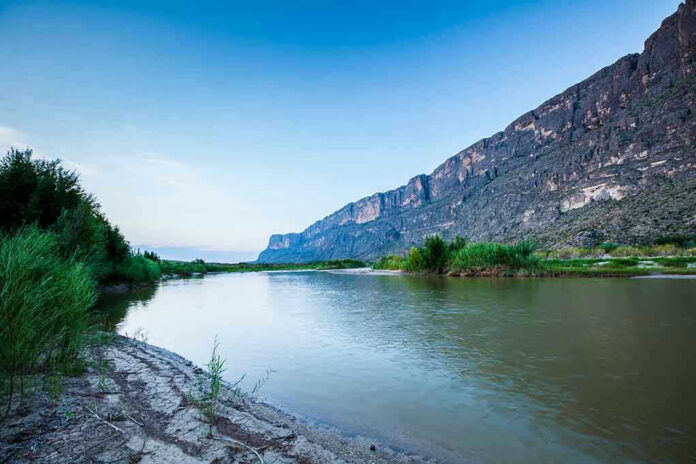
America’s vital Colorado River has lost water equivalent to Lake Mead’s entire volume from hidden underground aquifers, exposing a century of federal mismanagement now threatening millions under President Trump’s watch.
Story Highlights
- Since 2002, the Colorado River Basin lost 52 cubic kilometers of water, with 65% from irreplaceable aquifers detected by NASA satellites.
- Aquifer depletion accelerated three times faster from 2014-2024, mainly hitting downstream states like Arizona and California.
- The 1922 Colorado River Compact over-allocated water, creating a structural deficit that groundwater pumping cannot sustain long-term.
- 40 million Americans, farmers, and cities face water insecurity as reservoirs stabilize but aquifers shrink irreversibly.
- With 2026 Compact renegotiations looming, federal intervention risks prioritizing bureaucracy over practical American solutions.
NASA Satellites Uncover Hidden Losses
GRACE/GRACE-FO satellites measured 52 cubic kilometers of total water loss in the Colorado River Basin since 2002. Sixty-five percent, or 34 cubic kilometers, vanished from aquifers, matching Lake Mead’s volume. This equals 72% of federal reservoir capacity underground. Researchers like Mohamed Abdelmohsen confirmed these findings using NLDAS data. The discovery shifts focus from visible reservoir declines to invisible, permanent aquifer depletion amid chronic overuse.
Historical Over-Allocation Fuels Crisis
The 1922 Colorado River Compact divided 7.5 million acre-feet annually to Upper and Lower Basins, ignoring evaporation, drought variability, and Mexico’s treaty rights. This created a structural deficit of 1.2 to 1.5 million acre-feet yearly. By the 1960s, the river stopped reaching the Gulf of California due to U.S. agriculture and urban demands. NASA imagery from 2000 showed it vanishing into desert sands. Dams and diversions locked in over-allocation, forcing unsustainable groundwater mining.
Accelerated Depletion Hits Downstream Hard
A 2025 Arizona State University study detailed 13 trillion gallons lost from basin aquifers, tripling in speed from 2014 to 2024 versus prior decades. Downstream states—Arizona, California, Nevada—suffered most, while Upper Basin states like Colorado lost less but still 11.8 million acre-feet. Jay Famiglietti warned this pace is “not sustainable.” Farmers using 70% for irrigation and urban users pump deeper, risking well failures and higher costs as surface supplies dwindle.
Stakeholder Tensions and Federal Failures
Upper Basin states defend “use it or lose it” rights under the Compact, contributing involuntary cuts in dry years. Lower Basin states sue for enforced reductions amid heavier aquifer hits. Tribes hold unquantified rights, and Mexico relies on pulse-fed treaty flows. With post-2023 drought pacts expiring in 2026, Bureau of Reclamation mediates feuds. Experts like James Heath clarify temporary hydropower diversions return water, unlike aquifer losses. Both conservatives and liberals see elites prioritizing power over fixing this government-engineered scarcity.
Scientists finally know where the Colorado River’s missing water is going
https://t.co/gt2f7QSGiw— William Brown (@brkingsmtnwest) April 14, 2026
Impacts Threaten American Heartland
The basin supplies 40 million people, 15% of U.S. winter vegetables from Imperial Valley, and hydropower. Short-term, pumping costs rise and wells fail; long-term, irreversible depletion risks collapse without recharge. Reservoirs like Mead and Powell show bathtub rings but stabilized via 2023 cuts. Political battles intensify as states deadlock, forcing federal plans. This exposes how outdated compacts and bureaucratic gridlock undermine self-reliance, fueling shared frustration across political lines with a deep state more focused on control than conservation.
Sources:
USGS: Endpoint of Colorado River in Mexico
CPR: Colorado River diverted water in Glenwood Canyon
Wikipedia: Colorado River Compact
NASA Earthdata: Satellite data show decrease in Colorado River Basin aquifers
SCIRP: Journal paper on Colorado River
Colorado Sun: Colorado River below-ground reservoir shrinking