
Sixteen people were pulled from the Pacific with suspected shark-bite injuries after a predawn rescue far off Baja California, while 11 others remained missing.
Story Snapshot
- The United States Coast Guard rescued 16 people about 140 miles west of Ensenada after a mayday call.
- Several survivors had injuries described as consistent with shark bites, and were treated en route to San Diego.
- Authorities reported 27 people in the water; 11 were later listed as missing as the search was suspended.
- Officials said the route is often used for smuggling, but they have not confirmed this vessel’s purpose.
Coast Guard Rescue And Reported Shark-Bite Injuries
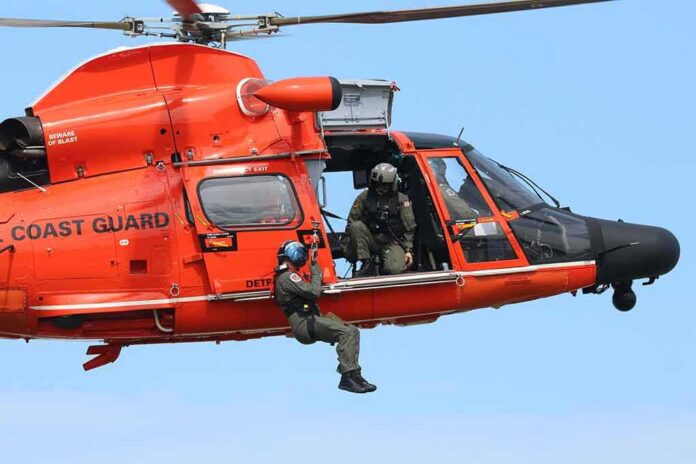
United States Coast Guard crews responded to a distress call around 1 a.m. on October 16, 2026, in the Pacific Ocean. The call reported a vessel taking on water about 140 miles west of Ensenada, Mexico. Crews located people in the water and debris from a lost boat, then pulled 16 survivors to safety. Coast Guard officials said several survivors had severe injuries consistent with shark bites. Medical teams gave first aid during transport to hospitals in San Diego.
Hospital staff in San Diego later confirmed treating people from the rescue. A Scripps Mercy Hospital spokesperson said three survivors arrived there, including one person treated for a suspected shark bite and two for cold exposure. The spokesperson did not release names. The Coast Guard said other survivors also received care. Officials did not identify the type of vessel that sank, and they did not list a cause for the loss at sea.
Scale Of The Emergency And Search Effort
Responders reported a total of 27 people in the water during the initial response. After recovering 16, search crews continued to scan the area for the others. Aircraft and cutters searched through the day and into the next, covering open ocean well outside United States waters. Authorities later suspended the search with 11 people unaccounted for. Officials said they found debris fields but no intact hull to examine for clues.
Officials emphasized the rescue location sat beyond the United States maritime boundary, off Baja California. That placed primary investigative authority with Mexican counterparts, with the Coast Guard focused on life-saving. Weather, currents, and time in the water all raised risks for exposure and marine life encounters. The long distance from shore reduced the odds of quick help from other boats. That delay can turn survivable mishaps into mass-casualty events.
Smuggling Concerns And What Is Not Yet Established
Coast Guard officials said the location and route are commonly linked to illegal maritime smuggling between Mexico and Southern California. That pattern fits years of cases involving crowded, unsafe boats making night runs along the coast. Officials, however, stopped short of saying this specific voyage was a smuggling trip. They said they have not confirmed the vessel’s purpose or operator. No public charging documents or passenger statements have established a smuggling enterprise in this case.
The available facts support two clear points. First, a large rescue occurred in rough circumstances far offshore. Second, several survivors had injuries described as suspected shark bites by both rescuers and hospital staff. At the same time, some details remain open in official statements. Authorities have not confirmed the exact number of people originally aboard, the vessel type, the cause of the sinking, or whether organized smuggling was involved.
Why This Matters For Public Safety And Policy
This event echoes a wider trend of dangerous sea crossings near California. Reported maritime smuggling events in the region surged in recent years, stressing coastal communities and rescue crews. More boats on risky routes raise the chances of tragedies at sea. Recent history includes fatal capsizes and nighttime landings that overwhelmed first responders. This pattern is driving pressure for stronger coastal patrols and clearer coordination with Mexican authorities to deter deadly trips before they launch.
Sixteen people were pulled from the Pacific early on Friday, 16 October, several with wounds consistent with shark bites, after their boat capsized roughly 140 miles (225 kilometres) west of Ensenada in waters associated with suspected migrant smuggling routes to California. pic.twitter.com/WNZT4dC4DA
— Jim Manzon (@manzonjj) October 19, 2026
For families on both sides of the border, the human costs come first. People in the water for hours face cold, dehydration, and predators. Rescuers race long distances in darkness with limited time to find survivors. For taxpayers, each mission demands aircraft, ships, and hospital care. For local residents, unsafe landings and mass rescues signal a system under strain. Many Americans across the political spectrum see a federal safety net that reacts late, rather than prevents harm early.
Sources:
usnews.com, cbc.ca, abc7.com, people.com
© primechronicle.org 2026. All rights reserved.