

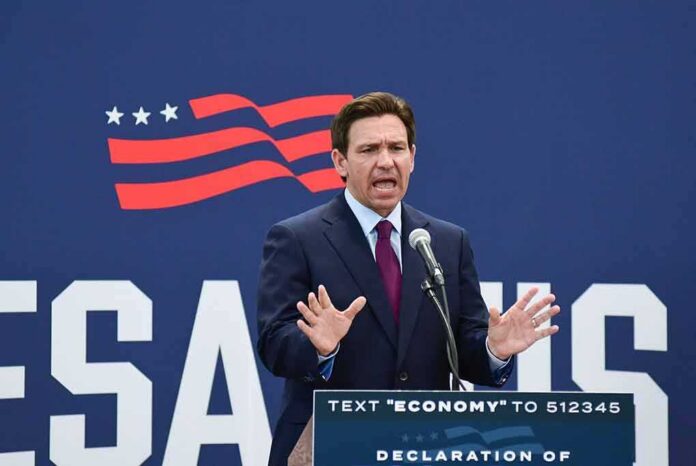
Florida Gov. Ron DeSantis warned that funding President Trump’s $5,000-per-adult “dividend” with new borrowing would drive more debt and more inflation.
Story Snapshot
- DeSantis said borrowing roughly $1.5 trillion for $5,000 checks would spur inflation and debt.
- Trump pledged the dividend if Republicans keep Congress; outside estimates peg costs at $1.2–$1.35 trillion.
- Economists say tariff revenue likely falls short, so debt would fund the plan, risking higher prices.
- Research and past experience show large transfers can lift inflation, depending on financing and the economy.
What DeSantis Said About Borrowing And Inflation
Florida Gov. Ron DeSantis said the country should not borrow another trillion and a half dollars to fund $5,000 checks. He argued that pouring that much new money into the economy would raise prices and push federal debt even higher. He added that if the government runs a surplus, leaders should cut taxes and return money that way. His warning highlights a growing rift inside the party over how to help households without stoking inflation.
DeSantis’s stance echoes a concern shared by many voters across parties. People feel Washington spends first and explains later. They remember how quick cash during the pandemic helped families but also helped push prices up. They want help that does not destroy buying power. His message taps that fear: more borrowing means more risk for savers, workers, and retirees who already struggle with higher rents, food, and insurance costs.
Trump’s Promise And The Price Tag
President Trump promised to issue a $5,000 “dividend” to every adult if Republicans keep control of Congress. He framed it as a reward from a strong economy. Independent estimates show a very large bill. Reuters put the cost near $1.2 trillion to $1.35 trillion, based on the number of adult Americans. That size matters because it shapes how the government would pay and how markets would react to the sudden jump in federal borrowing.
Trump has pointed to tariff revenue and new factory investment as support for the plan. Outside analyses say tariff income would likely not cover such a wide payout in one shot, which means debt would close the gap. Economists also warn that one-time checks tend to lift near-term spending, which can nudge prices up when supply is tight. That is why experts expect the plan to add inflation pressure if financed through new borrowing rather than offsetting cuts.
What History And Research Say About Transfers And Prices
Recent research on cash transfers finds they can raise demand and the price level, especially when the economy runs hot. Work tied to the International Monetary Fund shows transfer shocks can have large effects on output and also carry inflation risks. The impact depends on how the plan is financed and how the central bank responds. Debt-financed transfers can still push prices up if households spend a big share of the checks and investors demand higher interest to absorb new debt.
Trump says the $5,000 dividend "will happen", as elected Republicans line up publicly against it.
He gave no new detail on timing or funding, arguing Americans deserve to benefit from what he described as trillions of dollars of economic development and investment: "When I say…
— Tiberiade (@tiberiadex) September 12, 2026
During the pandemic, fast relief helped families but also helped lift prices. People saw their savings lose value as inflation outpaced pay. That memory shapes today’s reaction. Voters want straight math and clear trade-offs before Washington writes trillion-dollar checks. They worry both parties talk about helping the “little guy” while loading costs onto future taxpayers and seniors on fixed incomes. That mistrust is the backdrop for this fight over $5,000 checks and who pays the bill.
Why This Matters For Families And Markets
Households care about two things here: real buying power and job security. A $5,000 payment sounds big, but it shrinks if prices jump. If interest rates rise because of new debt, mortgages, car loans, and credit cards get more costly. Markets also watch the deficit path. A sudden surge in Treasury debt can push yields higher, which feeds back into budgets for families, cities, and small firms. That is the chain of risk DeSantis flagged in his warning.
Congress faces a simple but hard question: how to deliver help without repeating recent policy mistakes. Targeted tax relief funded by real savings is one path. Another is a smaller, offset plan tied to spending cuts. Leaders could also pair any transfer with reforms that lift supply, like faster permits for energy and housing. Those steps can cool price pressure while boosting growth. Voters across left and right want results, not more slogans and short-term fixes.
The Bottom Line
Trump’s $5,000 dividend aims to give fast help to adults. DeSantis warns the likely funding route is fresh debt that risks higher prices and bigger deficits. Independent estimates show a multi-trillion-dollar scale over time once interest is counted, and research ties large transfers to inflation in tight economies. The shared concern is simple: Americans do not want another policy that feels good now but makes the cost of living rise tomorrow.
Sources:
foxbusiness.com, abcnews4.com, usatoday.com, ntu.org, fortune.com
© primechronicle.org 2026. All rights reserved.