
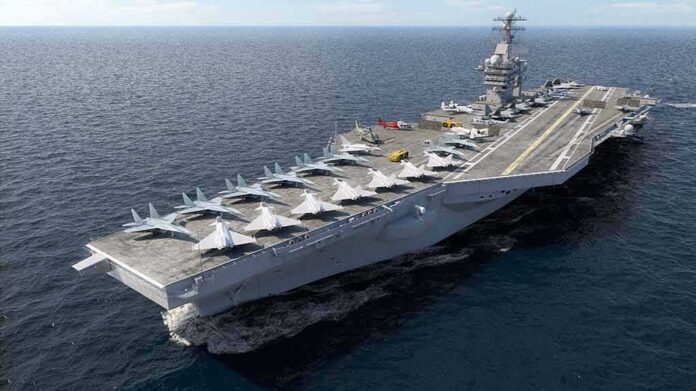
A growing chorus of naval analysts is reviving a wartime idea—small “escort carriers”—as missile threats push the U.S. Navy to spread out its airpower across the Pacific.
Story Snapshot
- World War II escort carriers handled convoy escort, close air support, and aircraft ferrying—roles analysts say still matter today.
- The Navy once operated a dedicated Escort Carrier Force, showing the concept worked at scale in war.
- Modern anti-ship missiles from China are driving new carrier-defense tactics and wider operating ranges.
- Commentary urges novel carrier employment, including decoys and distribution, under intense surveillance and strike pressure.
What Escort Carriers Did In War
World War II escort carriers were built to protect convoys, hunt submarines, and deliver close air support during island invasions. Smithsonian Air & Space records that the Navy designed them to guard shipping in the Atlantic and support troops in the Pacific. Defense accounts also show they shuttled aircraft to Australia and forward outposts, giving fleets a flexible air bridge across huge distances. These ships were slower and smaller, but they filled gaps that large carriers could not cover alone.
The Navy made escort carriers an organized combat tool, not a theory. Official history from the Naval History and Heritage Command documents a functional type command called the Escort Carrier Force in 1944. That structure let the fleet mass many small decks for sea control and close support, while preserving the big carriers for high-end strike. The model proved that more numerous, cheaper decks could add reach, resilience, and tempo when the fight spread across oceans.
Why The Idea Is Back On The Table
Today’s Pacific is defined by long ranges, satellites, and missiles that hunt big targets. Reporting in 2025 highlighted Chinese anti-ship missiles, including the DF-21 and DF-26, as major threats. The Navy is hardening defenses and extending the air wing’s reach with new tankers to keep carriers farther from danger. Analysts argue that spreading aviation across more ships could lower the risk that one missile salvo cripples U.S. striking power near key islands.
Independent assessments describe carriers working with escort warships to provide air and submarine defense while switching between screening and surge-strike roles. Other commentary goes further, suggesting the Navy may need unconventional employment, even using carriers as decoys at times, because of China’s surveillance networks and limited air-wing reach against distant targets. The thread across these views is clear: distribution can complicate enemy targeting and preserve options under fire.
How Escort Carriers Could Fit With Distribution
Distributed maritime operations aim to disperse combat power so an enemy must search for more ships and cannot cripple the force with one hit. Analysts say this approach lowers concentration risk while allowing the fleet to mass effects when needed through networks and shared sensing. Smaller aviation ships could push scouting, refueling, and close support closer to the fight, while large carriers stay farther out to launch strikes and provide heavy air defense.
Advocates point to the historical playbook for near-term missions: ferry aircraft forward, cover convoys and logistics ships, and provide close air support around chokepoints and beachheads. Those jobs are still hard, and they matter more as ranges grow. However, the public record includes no current Navy requirement to build escort carriers, and open sources do not specify size, cost, or survivability standards for a modern design. That limits how far the argument can go without fresh official studies.
Sources:
realcleardefense.com, en.wikipedia.org, defensemedianetwork.com, 19fortyfive.com, studyguides.com, history.navy.mil, cimsec.org
© primechronicle.org 2026. All rights reserved.