

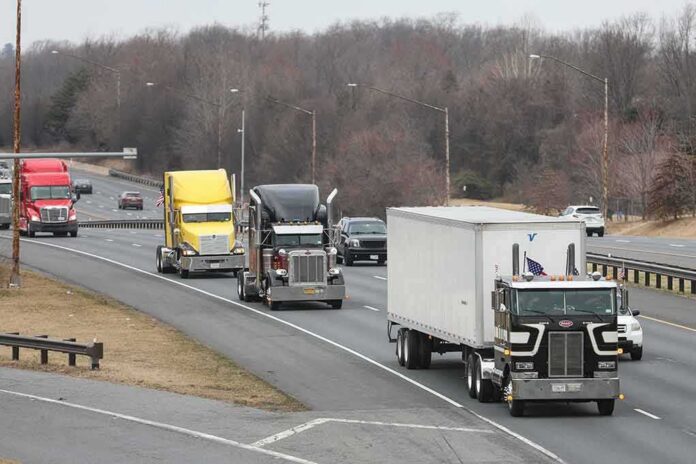
Transportation Secretary Sean Duffy says federal enforcement sidelined thousands of truckers over English rules, but the public record does not back a headline claim of 26,000 removals.
Story Snapshot
- Federal law requires interstate truckers to read and speak English for safety.
- The Transportation Department tied stricter enforcement to a deadly Florida crash.
- Washington penalized California for not enforcing English checks at the roadside.
- The touted “26,000 trucks” figure is not documented in the sources provided.
What Federal Rules Actually Require On English
Federal regulation says commercial drivers in interstate commerce must read and speak English well enough to talk with the public, read road signs, answer officials, and fill out reports. The Department of Transportation treats this as a safety rule. The Federal Motor Carrier Safety Administration directed states to test drivers at roadside and, when a driver fails, to order the driver out of service. The agency frames this as enforcing long‑standing law, not a brand‑new mandate.
Transportation Secretary Sean Duffy said past guidance had let violators stay on the road. He moved to restore out‑of‑service treatment for English failures and pushed states to apply it during safety stops. A Yahoo summary quoted Duffy citing earlier years when many violations were noted but few drivers were removed, arguing that the gap showed lax enforcement. Those specific totals were not paired with the underlying datasets in the materials we reviewed.
Why California Was Targeted And What Triggered The Crackdown
The Department of Transportation withheld more than $40 million from California after finding the state failed to enforce English checks and did not adopt compatible laws, according to the agency. Duffy tied the move to a review that followed a fatal Florida crash involving a foreign driver who made an illegal U‑turn, using the case to stress first‑responder and public safety needs, CNN reported. Federal officials also said California roadside inspections had flagged issues but rarely removed drivers.
Agency statements say California inspectors conducted about 34,000 inspections after the standards were rolled out, yet only one English violation led to an out‑of‑service order, and dozens of drivers cited in other states were allowed to continue in California, according to Duffy’s account reported by CNN. California’s detailed inspection logs were not included in the record here, so independent auditing of those claims is not possible from these materials alone. The funding penalty raised the stakes for state compliance.
What We Know—and Do Not Know—About Outcomes And Counts
The Transportation Department and the Federal Motor Carrier Safety Administration say stronger English checks protect road users and first responders. The administration also linked this to broader steps on license integrity and inspections, which it cast as a safety package, not only a language test. However, the sources provided do not include crash‑rate studies that tie English removals to fewer collisions. They also do not show before‑and‑after risk analysis to measure impact.
Some reports and commentary cite large removal totals in recent months, but the headline claim that “26,000 trucks” were taken off the road is not documented in the primary federal release or in the CNN and trucking‑industry summaries supplied here. Duffy has referenced earlier violation counts to argue past enforcement was weak, but those numbers were not independently verified within this packet. The lack of public, method‑matched datasets limits firm conclusions on scale and effect.
Why This Fight Resonates Across Ideology
People want safe highways and fair rules. Many also believe Washington and state agencies act first and show proof later. Supporters see English checks as common sense that lets officers, tow crews, and medics do their jobs. Critics worry that rushed crackdowns shrink driver ranks, raise shipping costs, and blur safety with immigration politics. Both sides point to the same gap: officials have not yet produced clear outcome data that shows the policy reduces crashes in a measurable way.
🇺🇸🚛 I support @SecDuffy putting SAFETY FIRST in American trucking.
Enforce English proficiency. Stop illegally issued CDLs. Get unqualified drivers off our highways.
But don’t forget the professional drivers who did it right.
I’m an Italian-American trucker: 1M+ safe miles… pic.twitter.com/cTtJFfPoa3— Albert Trucker 🦅🇮🇹🇺🇲🚚 (@aicazabarza) August 14, 2026
For readers who want answers beyond talking points, three steps would help. First, release the roadside inspection and out‑of‑service data tied to English violations by state and month. Second, publish a crash study comparing drivers removed for English failures with similar drivers who were not. Third, post the training and testing rules used by inspectors so the public can see if checks are fair and consistent. Hard numbers, not slogans, should decide how we police the nation’s roads.
Sources:
mediaite.com, edition.cnn.com, wgxa.tv, yahoo.com
© primechronicle.org 2026. All rights reserved.