
President Trump drew a packed Montana crowd and told voters that Republican wins would protect gun rights and reshape Congress.
Story Highlights
- Trump headlined a Kalispell rally to boost GOP candidates Aaron Flint and Kurt Alme
- Event fit a wider midterm roadshow billed as a multi-state push to rally Republicans
- Gun rights dominated Trump’s message as he urged voters to turn out
- Press-access fights trailed the trip, adding a parallel First Amendment storyline
Trump Rallies GOP Voters in Kalispell for House and Senate Races
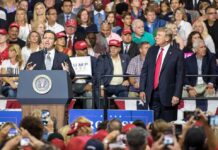
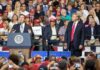
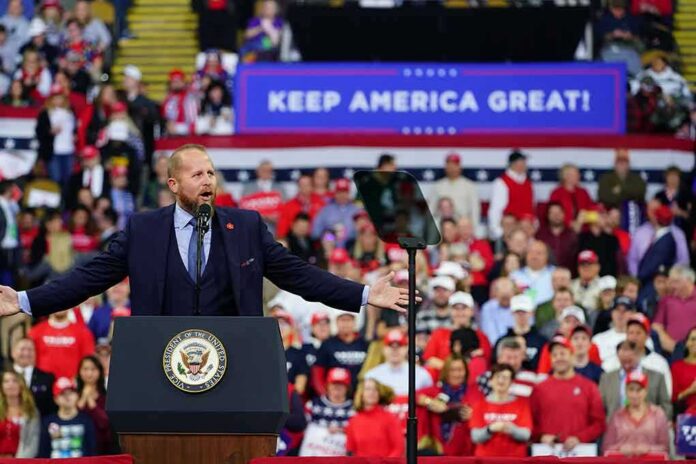
President Trump held a midterm campaign rally on October 14, 2026, at the Majestic Valley Arena in Kalispell, Montana. He urged voters to elect Republican House candidate Aaron Flint and Republican Senate candidate Kurt Alme. Trump criticized Flint’s Democratic opponent, Sam Forstag, while asking the audience to “get out and vote.” Local and national outlets described a large, energetic crowd and active participation from state Republican leaders at the event.
Associated Press reporting said the rally placed strong focus on gun rights. Trump told supporters that voting Republican would ensure the Second Amendment remained untouched. The issue has long energized conservative voters in Montana, where hunting and gun ownership are part of daily life. The message aligned with the campaign’s push to firm up support in Republican-leaning areas while lifting candidates in close races. The rally served as both a recruitment moment and a show of party unity.
Part of a Multi-State Midterm Push Framed as a GOP “Roadshow”
Public broadcasters and wire services described the Montana stop as part of a Western swing to rally Republicans before the midterms. The tour included Arizona and aimed to help the party limit expected losses that often hit the president’s party in midterm years. White House aides called the schedule a “midterm blitz,” signaling an organized push with multiple events over several weeks across key regions.
Historical trends show why presidents lean on rallies during midterms. Since 1946, the president’s party has lost United States House seats in 18 of 20 midterms. That 90 percent pattern sets a high bar for any governing party hoping to keep or grow its majority. Campaign travel is a standard tool to energize voters, raise money, and frame the stakes in local races that can tip control of Congress.
Turnout Goals, Local Officials, and What We Can and Cannot Measure
Local reporting said the Kalispell arena filled up, with notable Montana Republicans in attendance. Coverage highlighted Senator Steve Daines, Representative Ryan Zinke, and other statewide figures who rallied alongside Trump. Large crowds can help recruit volunteers and donors, but they do not prove a change in vote share on their own. The reporting did not include controlled data tying the rally to turnout gains or polling shifts for the named candidates.
Academic research suggests rallies can boost turnout at the margins. A recent county-level study linked rallies to a roughly one to two percent turnout lift, a small but real effect that can matter in tight races. That research did not prove persuasion of undecided voters, which is harder to detect and may require broader outreach beyond rally-goers. Still, campaigns often bank on these events to spark local momentum in the final stretch.
Press Access Fight Adds an Institutional Flashpoint
The trip unfolded as the White House faced a widening fight with national outlets over access. A federal judge moved to block bans that had kept some reporters out of the White House complex. The dispute did not automatically grant access to the Oval Office or Air Force One, but it forced changes to previous restrictions. The legal back-and-forth kept press freedom concerns in the frame during campaign coverage.
There's not one credible poll or election news story out there that's favorable for Trump. And it's not for any other reason than he is deeply unpopular with the American people.
You can continue to deny it all you'd like, but you'll be in for a not-so-pleasant surprise come… pic.twitter.com/xIh9MR5uYI
— Eric Jay (@EricinAmericaX) October 14, 2026
Separate reports said the White House removed Cable News Network from a press pool for a Texas and Oklahoma trip, and the network said it was left off Air Force One for a Saturday flight. These actions fueled a First Amendment subplot alongside standard campaign reporting. That tension risked drawing attention away from Republican candidates’ messages, even as party leaders tried to keep the focus on turnout and local issues.
Sources:
youtube.com, washingtonpost.com, nbcnews.com, apnews.com, pbs.org, flatheadbeacon.com, presidency.ucsb.edu, brookings.edu
© primechronicle.org 2026. All rights reserved.