
A North Carolina couple and their two dogs walked away after their single‑engine plane lost power at night and stopped in the treetops instead of slamming into the ground.
Story Snapshot
- The pilot reported engine power loss around 6,000 feet during a night flight.
- The Federal Aviation Administration confirmed mechanical trouble before the plane hit trees.
- The couple and both dogs escaped with minor injuries after a treetop landing.
- Investigators are reviewing what caused the power loss; no cause is confirmed yet.
Nighttime Power Loss Leads to Emergency Descent
Reporters identified the couple as Dustin and Autumn Davis, who were flying a single‑engine Piper PA‑32 over Columbus County on October 7 when the engine stopped producing power during a night flight. Davis said he and his wife worked their checklists and called air traffic control as altitude unwound and options narrowed. The Federal Aviation Administration stated the airplane had mechanical trouble before it hit trees, aligning with the pilot’s account of a power loss. Both dogs were aboard and survived with the couple.
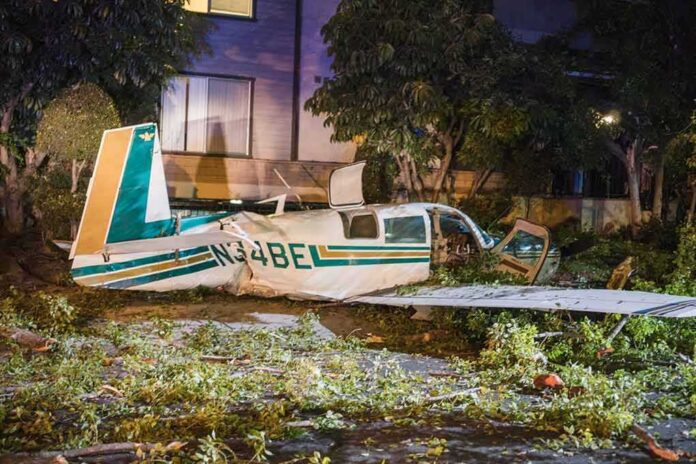
Local outlets describe a tense few minutes as the dark terrain below offered few clear landing spots. Davis recalled seeing trees and choosing to pull up at the last moment to reduce speed and angle, a standard technique to protect the cabin during a forced landing. The aircraft then struck and rode through the canopy before coming to rest above the ground. Photos shared with reporters showed the nose close to the dirt but not buried, consistent with a tree‑supported stop.
Treetops Turn a Crash Into a Survivable Landing
Witness accounts and images point to a treetop landing rather than a direct ground impact, with the airplane ending up about six feet above the ground after striking a smaller, flexible tree that absorbed energy. Other descriptions say a stout tree halted the slide as the belly took the load, leaving the nose inches from the ground. Minor differences in altitude figures and tree details appear across reports, but all agree the trees slowed the plane and protected the cabin.
Both passengers walked away with minor injuries, including a black eye and soreness, and both dogs survived, according to follow‑up local reporting. That outcome fits what safety training stresses for forced landings: keep control, reduce speed, and let the airframe and terrain absorb energy. Pilot groups and safety materials teach that “controlled crashing” into a chosen area often saves lives when power is lost and runway options are gone. In this case, trees limited the final impact and likely helped preserve the cabin space.
What Investigators Will Try to Answer Next
Officials from the Federal Aviation Administration and the National Transportation Safety Board are reviewing what caused the power loss, which remains unknown in public reports. Investigators typically examine fuel quality, fuel system lines, engine components, and recent maintenance. They also match pilot statements with air traffic control recordings and any flight‑tracking data to confirm altitude, speed, and descent profile. That process can take weeks or months before a preliminary summary and, later, a probable cause.
General aviation safety material shows that engine problems are a recurring factor in accidents, but loss of control often turns an emergency into a fatal crash. Training from pilot organizations explains how choosing a landing area, managing speed, and keeping the wings level boosts survival odds during a forced landing. Federal Aviation Administration guidance also warns that nighttime emergencies compound risk, as pilots may not see trees or wires until the final seconds. Those themes echo in the Davis account reported by local outlets.
Why This Resonates Beyond One Family’s Close Call
Many readers see stories like this and think about how fragile safety can be when systems fail. People on the left and right both worry that basic infrastructure, oversight, and accountability often lag while leaders in Washington argue. This event is not about politics, but it underlines a shared concern: when a machine fails, the outcome depends on training, preparation, and honest follow‑through after the fact. Clear findings from investigators help pilots learn and help families trust the system.
Sources:
nypost.com, wsoctv.com, wwaytv3.com, aopa.org, us.headtopics.com
© primechronicle.org 2026. All rights reserved.