

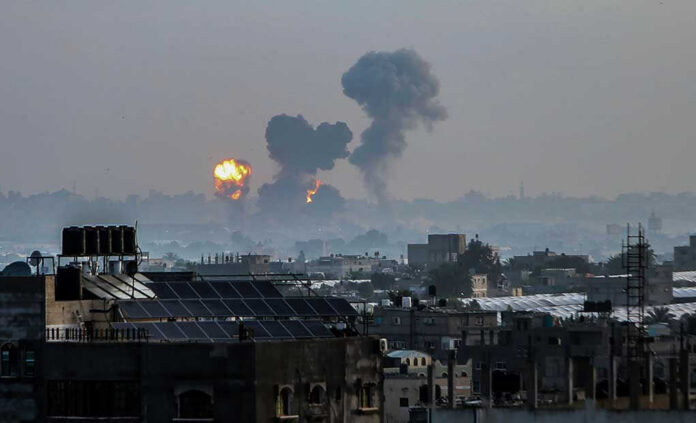
A Russian drone reportedly struck a Chinese-owned cargo ship near Odesa, risking a wider international flashpoint and spotlighting the dangers of unchecked drone warfare at sea.
Story Snapshot
- Ukraine says a Russian strike drone hit a Chinese cargo vessel near Odesa amid ongoing attacks on the city’s infrastructure [3][4][5].
- Recent Odesa strikes killed civilians and damaged residential and commercial sites, with casualty counts varying across reports [3][4][5][6].
- Reports describe broad, multi-site damage patterns in Odesa consistent with area effects, while Russian target intent remains unverified [3][4][5].
- Escalating cross-border drone warfare raises risks for global trade and maritime safety in the Black Sea [3][4][5].
Reported Strike On Chinese Cargo Ship Near Odesa
Ukrainian accounts circulating alongside social media reporting say a Russian strike drone hit a Chinese-owned cargo vessel near Odesa as maritime traffic transited the Black Sea corridor. While the immediate shipboard damage details remain limited in the public record, the incident surfaced as part of a broader pattern of Russian drone activity that has repeatedly targeted the Odesa region’s logistics and urban infrastructure during the war [3][4][5]. The claim, if fully confirmed, would mark a dangerous expansion of risk to neutral commercial shipping.
Ukraine-linked updates have framed the ship incident within the same overnight cycle that saw strikes on Odesa’s districts, heightening concern that spillover from land attacks is endangering sea lanes crucial to grain, fuel, and manufactured goods. The broader Black Sea corridor, already strained by previous port strikes and insurance spikes, could face new premiums and routing disruptions if non-combatant vessels continue to be threatened by long-range drones and missiles operating near busy approaches [3][4][5].
Civilian Harm In Odesa And Unclear Target Intent
Recent reporting on Odesa documents civilian casualties and damage to residential and commercial structures. Reuters-syndicated coverage relayed that a married couple was killed and over a dozen people were injured; other outlets recorded injury counts ranging from 13 to 20 in separate overnight attacks as assessments evolved [3][4][5][6]. Descriptions of hits on apartments, a hotel, warehouses, and other civilian objects across multiple districts indicate wide-area effects, while no definitive Russian Ministry of Defense target specification has appeared in the supplied material [3][4].
Accounts attribute the attacks to Russian drones and describe impact patterns spanning several neighborhoods, which strengthens the case for broad civilian impact but does not, by itself, establish deliberate intent against civilians. The available record does not include primary Russian targeting documentation or geolocated forensic analysis tying specific damaged structures to military use. That evidentiary gap leaves key legal questions unresolved even as the toll on residents and property is documented by Ukrainian officials and relayed by international outlets [3][4][5].
Wartime Context: Cross-Border Drone Escalation
The strikes in and around Odesa occurred amid an intensifying exchange of long-range drones by both sides, with Ukraine also conducting deep strikes against Russian energy and industrial targets as part of its counter-pressure operations. This reciprocal environment allows Moscow to frame its actions as degrading enemy capacity, while Kyiv emphasizes civilian harm and the hit to vital infrastructure, including port-adjacent facilities. In this information contest, early narratives harden quickly, often before independent verification refines incident details [3][4][5].
In the morning a Russian strike drone hit the dry cargo ship KSL Deyang, which was in the sea near the Odesa region.
The ship flies the flag of the Marshall Islands, but belongs to the Chinese company KSL, and its crew consists of Chinese citizens. pic.twitter.com/zlK8DRusJA
— PPN – PulsePoint News (@wogoa1) May 18, 2026
For American readers concerned about energy prices, shipping stability, and food costs, the Black Sea’s security matters. Disruptions to cargo routes and port operations can ripple into higher insurance, freight, and commodity prices worldwide. Absent clear rules of engagement that protect neutral shipping, more commercial vessels could be caught in the crossfire, empowering bad actors and undermining the sovereignty of maritime trade. Strengthening deterrence, transparency, and verification would serve peace through strength and safeguard lawful commerce.
Accountability, Evidence, And Next Steps
Future clarity will depend on verifiable data: impact-point mapping, weapon-remnant identification, and site-by-site occupancy audits to determine whether any struck Odesa structures were used for military logistics. For the reported cargo ship incident, hull damage assessments, crew statements, and satellite tracking could confirm the precise location, timing, and munition type. Without such documentation, accusations and denials will continue to outpace facts, leaving civilians and shippers exposed as the Black Sea remains an active risk zone [3][4][5].
Sources:
[3] Web – Russian Attack on Odesa Kills Married Couple, Injures Over a Dozen
[4] Web – Massive drone attack on Odesa: at least 13 people injured | УНН
[5] Web – Ukraine says 20 injured due to overnight Russian drone strikes on …
[6] Web – 9 Dead, 23 Injured in Odesa as Russia Launches One of Largest Air …