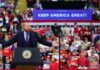

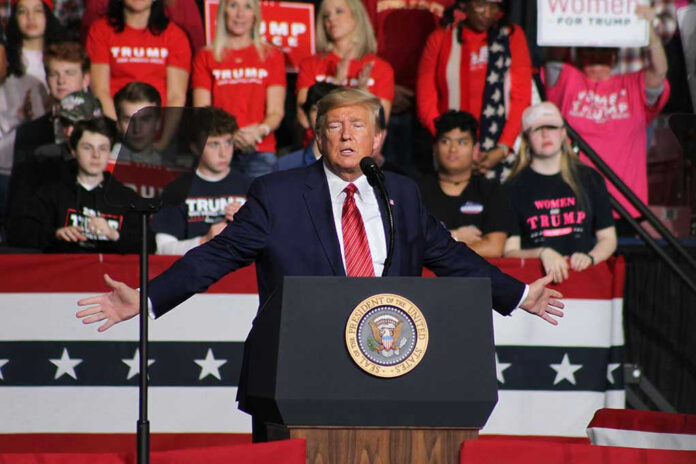
On America’s 250th birthday, President Trump used a “golden age” July 4th speech to praise a reborn nation while warning that a “communist” threat and a broken political system are still holding everyday Americans back.
Story Snapshot
- Trump cast the United States as entering a **“golden age of America”**, claiming the country has been “saved” and is stronger than ever.
- His July 4th remarks mixed founding-era history and patriotic stories with sharp attacks on “communists,” Democrats, and mail‑in voting rules.
- The event cost tens of millions in taxpayer money and drew criticism over low turnout, shaky logistics, and ties to Trump‑aligned political organizers.
- The speech highlights a wider trend: both parties’ leaders using national holidays to score political points while many Americans feel shut out of the American Dream.
Trump’s “golden age” message and claims of a saved America
President Trump’s July 4th speech on the National Mall came during America’s 250th birthday and his second term in office. He told the crowd that for “two and a half centuries” the American Republic has stood as the “crowning achievement of human history” and insisted the nation is “doing better now than we’ve ever done before.” In language echoing his recent State of the Union, he described a “golden age of America,” saying the country is “back — bigger, better, richer and stronger than ever before.”
Trump framed the celebration as proof that the country has been pulled back from the brink. In a clip shared widely on social media, he declared, “We have reclaimed our sovereignty, regained our liberty, restored our prosperity, and we have saved our country.” He called the gathering “an evening for the ages” and promised a very long speech to honor the nation’s past and future. This tone appealed to supporters who feel his America First agenda finally pushed back against global elites, high inflation, and years of ignored border problems.
Patriotism, founding history, and fierce warnings about communism
Trump filled much of the speech with stories from American history, including references to the founding fathers, historic flags, and Medal of Honor heroes. Several veterans joined him on stage, sharing their experiences as he praised their courage and sacrifice. This historical focus fits a long tradition of presidents using Independence Day to remind Americans of core ideas like individual rights, faith, and resistance to government overreach. For many listeners across the political spectrum, these themes lined up with deep frustration that today’s leaders have strayed from those values.
Yet alongside the patriotic rhetoric, Trump warned that America faces a “communist cancer” at home and abroad. He attacked Democrats and unnamed “communists” for using mail‑in ballots and big government power to tilt elections and expand control over everyday life. According to the New York Times, he even used the holiday speech to push Congress to restrict mail‑in voting so that, in his words, “there will be no mail in ballots” except in rare cases. Those lines hit a nerve for conservatives worried about election integrity, but they also fueled fears among liberals of voting rights being rolled back.
The money, the crowd, and questions about who benefits
The July 4th event itself became part of the controversy. Reports said the celebration cost about $68 million in taxpayer funds, with significant payments going to Event Strategies Incorporated, a company run by Trump allies that also helped organize the January 6 Ellipse rally. That detail raised alarms for both conservatives and liberals who already believe Washington insiders and political consultants profit from public money while regular Americans struggle with housing, health care, and retirement savings.
Coverage from NPR and other outlets described the crowd on the National Mall as “sparsely attended,” with large areas left empty despite White House talk of huge turnout. A viral video from MeidasTouch showed rows of open space and mocked the event as “empty as advertised.” Even some commentators on right‑leaning networks admitted the spectacle did not match the grand image promoted beforehand. For many Americans watching from home, the empty patches on the grass looked like a symbol of how distant national politics now feels from their daily lives.
Holiday speeches, deep frustration, and a shared distrust of elites
Debate over Trump’s July 4th speech fits a wider pattern in modern politics. Research on presidential Independence Day addresses shows they are less “apolitical” than in the past and more likely to mix patriotic celebration with sharp political messages. Earlier presidents, such as Ronald Reagan in 1986, used the day to stress unity across lines of race, religion, and party, saying “Republican and Democrat, we are all Americans.” Today’s speeches instead often double as campaign‑style events, feeding the sense that national leaders care more about winning than governing.
@CNN
Trump warns of communist 'cancer' at campaign-style July 4 speech (Reuters)Why is Trump talking about communism?
For the 2026 Midterms he will claim ALL Democrats are communists; while Trump praises communists Putin, Orban, and others!
Trump is DESPERATE! pic.twitter.com/NVyUgfYnUS— TheWraithRidesAgain (@TheWraithRides) July 5, 2026
Trump’s focus on a “golden age,” communism, and election rules taps into real anger felt by many Americans, but from different directions. Older conservatives see the speech as a defense of sovereignty, energy independence, and law‑and‑order after years of “woke” policies and global trade deals. Older liberals hear it as another attack on voting rights, immigrants, and dissent, while the wealthy and politically connected grow richer through things like crypto ventures that have brought Trump’s family at least $2.3 billion since his return to the White House. Both sides, however, share a growing belief that the government and its partners serve themselves first and the people second.
Sources:
cbsnews.com, youtube.com, facebook.com, instagram.com, nytimes.com, thehill.com, akingump.com, federalregister.gov, jfklibrary.org, tpmap.org
© primechronicle.org 2026. All rights reserved.