
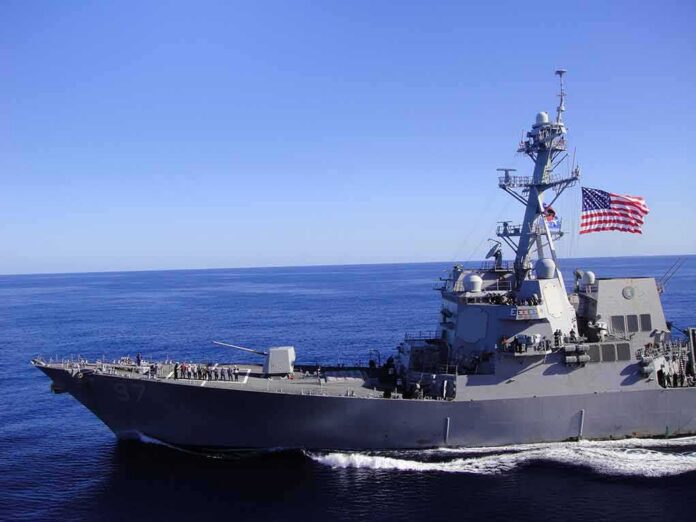
U.S. forces fired on a Panama-flagged ship in the Gulf of Oman after saying it tried to break the blockade of Iranian ports, pushing a maritime standoff into a sharper and more dangerous phase.
Quick Take
- The vessel was identified as the Vela Nova, a Panama-flagged container ship.
- Reuters said a U.S. military helicopter fired at the ship’s rudder after warnings were ignored.
- Maritime security firm Vanguard gave a different damage description, saying the ship was hit by a missile and caught fire.
- The public record in the provided sources does not include the ship’s logs, radio traffic, or tracking data.
What the U.S. Said Happened
Reuters reported that a U.S. official said the ship ignored warnings from personnel enforcing a naval blockade on Iranian ports. The same report said a U.S. military helicopter fired at the rudder of the ship. The Wall Street Journal’s account, echoed by other outlets, framed the incident as an enforcement action against a vessel that tried to run the blockade.
That account fits a wider pattern in this conflict, where U.S. forces have already used blockade language and disabling fire in earlier incidents. Those past releases matter because they show this was not a one-off improvisation. They also show how quickly maritime clashes can turn into a public story built first from official claims, then from later technical records.
Where the Reporting Still Divides
The public reporting does not tell one clean story about how the strike unfolded. Reuters said the helicopter fired at the rudder after warnings were ignored, while Vanguard said the vessel was hit by a missile and that a fire was later extinguished. Those are not minor wording differences. They change how readers understand both the level of force used and the damage that was actually done.
Just as important, the available material does not include the ship operator’s account, bridge audio, or AIS data showing the vessel’s course changes. That means the intent claim rests on a U.S. official’s statement, not on a public tracking record. In a region already shaped by war, sanctions, and reprisals, that gap leaves plenty of room for later dispute over what the ship was doing and why it kept going.
Why This Incident Matters Beyond One Ship
The Strait of Hormuz and nearby waters sit at the center of global energy shipping, so even one strike can move markets and raise the risk of retaliation. Reports in the provided material say the vessel was in the Gulf of Oman and that there were no immediate casualty reports. That makes the event smaller than a naval battle, but far bigger than a routine inspection or warning at sea.
The deeper problem is credibility. When governments, security firms, and wire services rush out versions of the same event before the primary record is public, the first story often becomes the lasting one. Supporters of the U.S. line will see a lawful enforcement action. Critics will see another example of force-first policy and selective disclosure. Both reactions grow from the same fact: the public still lacks the underlying technical record.
1 AM Top-of-the-Hour News
The drive by shooting on the Vegas Strip, three decades ago…Monday morning,, the only person ever charged in the 1996 murder of rapper Tupac Shakur is set to go on trial in Las Vegas when jury selection gets underway. prosecutors don't believe Dwayne… pic.twitter.com/BqhaSW42sh
— Worldwide News Network (@WorldwideNNX) August 10, 2026
If later logs, transcripts, or forensic damage reports surface, they will matter far more than the early headlines. For now, the case stands as a sharp example of how quickly maritime conflict can harden into accepted truth before the evidence is fully open. In this kind of fight, the ship is not the only thing being targeted. The story itself is, too.
Sources:
theamericanconservative.com, ynetnews.com, bbc.com, nbcnews.com, bostonglobe.com
© primechronicle.org 2026. All rights reserved.