
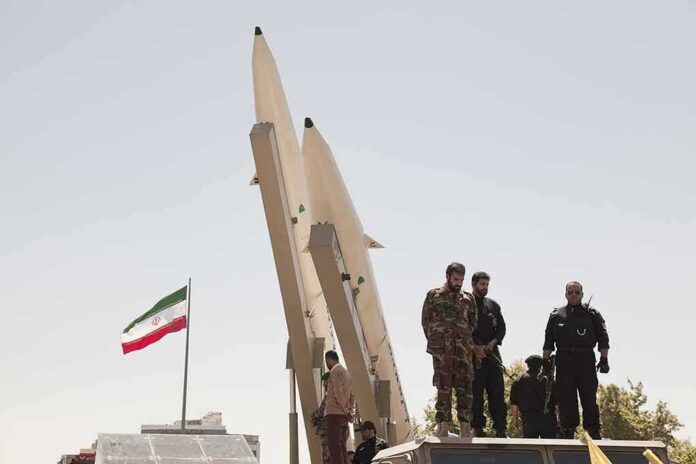
Iran’s military command warned that any new U.S. strike would prompt attacks on “all U.S. bases in the region,” a threat that could pull host nations into the line of fire.
Story Highlights
- Iran’s military warned it would hit all regional U.S. bases if attacked again.
- Officials said retaliation could be “without limitation” and widen the battlefield.
- The warning extended to countries that host U.S. forces, not just the United States.
- U.S. framing describes recent strikes as limited and precise, not a step to widen war.
Iran’s Warning and What It Means for Regional Hosts
Iran’s Khatam al-Anbiya Central Headquarters and the Islamic Revolutionary Guard Corps said a new U.S. assault would trigger sustained and painful strikes on all U.S. bases and interests in the region. Iranian outlets also quoted commanders saying responses would be continuous and without limitation, with vows to change the “geography of the war” if fighting resumes. Earlier this year, Iran warned Arab states that host American forces to prepare their civil defense and expect direct risk if conflict escalates.
These statements land hard because they target the network that lets Washington project power. Bahrain, Qatar, Kuwait, the United Arab Emirates, Jordan, and Iraq all host U.S. facilities. If Iran acts on its threat, those countries could face missile and drone attacks as part of a wider battlefield, not just over Iran itself. That puts local leaders in a tight spot. They rely on U.S. security, but they also must answer to citizens who fear becoming targets.
Evidence and Limits: What We Know and Do Not Know
Iranian claims of past strikes on U.S. bases exist, including reports of missile and drone shots at sites in Jordan and across the region. Iranian coverage has even described bases as “destroyed,” which the United States has not confirmed in the supplied record. The strongest proof today is declaratory. Iran has clearly issued written and on-the-record warnings, and local media reported a highest alert status for Iranian forces after earlier exchanges. But outside verification of exact phrasing and plans remains thin.
That gap matters for risk assessment. Public threats can serve several goals at once. They can deter new attacks by raising the expected price. They can rally a home audience by showing resolve. They can also pressure host nations to distance themselves from Washington. Analysts call this strategy coercion by widening the map: turn a two-party fight into a regional cost that allies must weigh. The warnings fit that pattern, even as details of any follow-on plan stay opaque.
How Washington Frames Its Moves
U.S. officials have described recent strikes on Iran-linked targets as narrow and precise. Military statements said actions aimed to degrade Iranian command, missile, and drone systems that threaten shipping and regional stability, not to expand the war. That framing seeks to calm markets, reassure partners, and avoid giving Tehran a public reason to escalate further. It also signals that Washington believes it can contain the conflict to limited targets and time windows.
The divide in narratives is stark. Iran says any renewed attack opens every U.S. base in the neighborhood to retaliation. Washington says its aim is targeted defense and deterrence, not escalation. When those stories collide, misread signals can cause real harm. A strike meant as “limited” can still lead to a broader response if the other side’s doctrine links attacks to every regional node that supports U.S. power.
Why This Matters at Home
American families and service members pay the price when wars widen by drift or by design. Voters across left and right worry that Washington’s foreign system is on autopilot, guided by the same elite circles that rarely feel the fallout. Rising energy prices, trade shocks, and base attacks abroad can all ripple into jobs and savings here. Clear goals, legal authority, and defined off-ramps help prevent another open-ended commitment without a finish line.
Iran hands US a new set of conditions for restarting negotiations, warning of retaliation without limitations if any new attacks occur. Reza Hatami has more pic.twitter.com/0QWitWUAIW
— TRT World Now (@TRTWorldNow) September 21, 2026
Regional governments face hard choices too. Hosting U.S. forces brings training, defense ties, and deterrence. It also paints a target on key infrastructure when tensions spike. If Iran believes hitting those bases shifts costs onto U.S. partners, pressure will grow on those leaders to restrict access, even quietly. That is the heart of Tehran’s message: change the map, change the math. Whether that works will depend on how the United States, allies, and Iran manage the next move.
Sources:
cbsnews.com, en.mehrnews.com, tasnimnews.ir, tribuneindia.com, tabnak.ir, nytimes.com, npr.org
© primechronicle.org 2026. All rights reserved.