
Newly declassified video and a first-hand account confirm a two-day U.S. rescue deep inside Iran that brought an injured Air Force officer home alive.
Story Highlights
- CBS reports the officer, call sign “Bravo,” survived 48 to 50 hours in Iran before rescue.
- Both F-15E crew members ejected after an Iranian missile strike; the pilot was recovered within hours.
- Declassified footage shows elite pararescuers grabbing Bravo and lifting him out.
- The mission drew on a large, complex operation that put U.S. forces inside hostile territory.
What The Airman Says Happened
CBS News reports that an Air Force colonel, identified only as “Bravo,” gave his first public account on 60 Minutes. He described ejecting after an Iranian missile hit his F-15E in April. He landed injured and alone in the mountains and then spent two days avoiding capture. He said he managed pain, hid from searchers, and kept faith that help would come. CBS says his pilot was rescued within hours, while Bravo was found and recovered about 50 hours later.
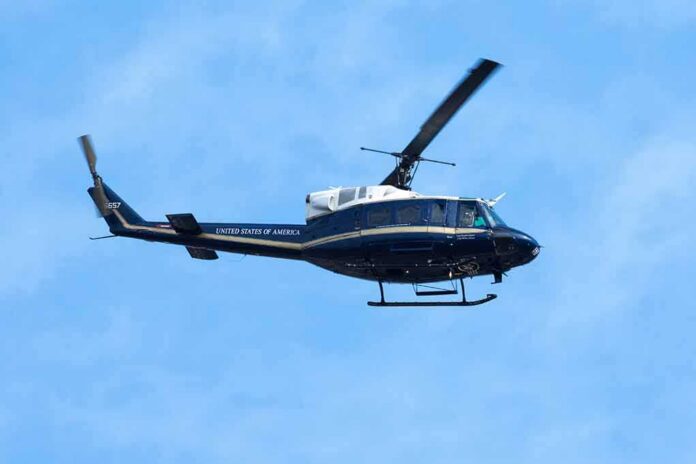
According to CBS, newly released video shows the dramatic end of Bravo’s ordeal. The footage captures two Air Force pararescuers reaching him and hauling him into a helicopter as dawn broke. It is rare to see this kind of recovery on camera, and the images match the timeline CBS reported. The network frames the mission as one of the largest and most complex personnel rescues in modern United States military history.
How The Rescue Unfolded
Published accounts from CBS say Iranian air defenses struck the jet, forcing both crew to eject. U.S. forces moved fast to locate both men and to keep Iranian units at bay. The pilot linked up with rescuers within hours. Bravo’s extraction took longer and required more steps on the ground. The New York Times reported that United States special operations forces went deep into Iran for the Saturday night pickup, and all returned safely.
PBS NewsHour also reported that the United States pulled off a daring recovery of the two aviators after the shootdown. Their account aligns with the basic sequence. One airman was rescued first. The second recovery became more complex and stretched into a second day. That description tracks with the call sign based reporting and the declassified video of the final lift.
Why This Matters At Home
This mission highlights a simple promise many Americans still expect the government to keep: do not leave people behind. The story shows what that looks like in practice. It took speed, risk, and a lot of coordination to bring an injured officer home from hostile ground. People on the right and the left can see both the courage and the cost. Big operations like this are expensive and dangerous, yet they uphold a core duty to those who serve.
US aviator describes 'free-falling' after F-15E shot down over Iran
A US Air Force officer, identified as Bravo, recounted "free-falling" with a damaged parachute after his F-15E jet was shot down over Iran in April. He described the ordeal, which included evading Iranian forces…
— PiQ (@PiQMarkets) September 14, 2026
The rescue also shows how much the public learns through selective release. CBS used call signs and left out many specifics to protect people and tactics. That is normal in these cases. Still, it means most of us will only see parts of the record. Even so, on the facts that are on the record, the picture is clear: both crew ejected, both survived, and a large United States team brought them home alive.
Sources:
© primechronicle.org 2026. All rights reserved.