

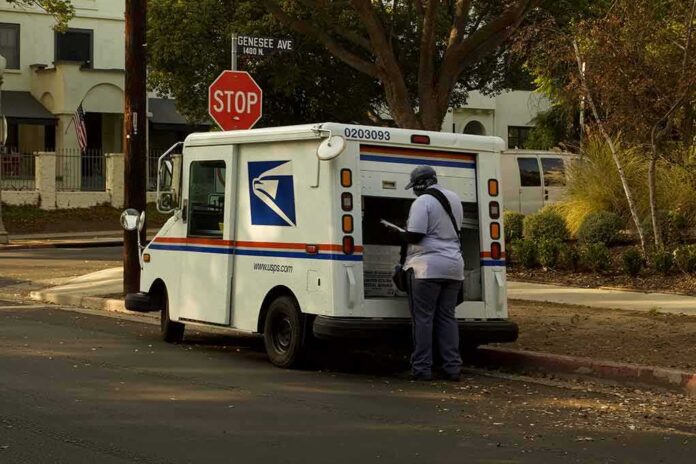
The Supreme Court kept lower-court blocks in place and stopped the Postal Service’s new mail-ballot rule from taking effect before November.
Story Snapshot
- The Supreme Court declined to revive a Postal Service rule that would have added new mail-ballot steps this fall.
- Lower courts said the rule likely regulates elections without clear approval from Congress.
- The Postal Service said states would upload voter names, addresses, and barcodes to a federal portal before mailings.
- Officials warned the portal was not yet ready and no election staff had been trained on it.
What the Supreme Court Did and Why It Matters
The Supreme Court denied the Trump administration’s emergency bid to enforce the U.S. Postal Service’s final mail-ballot rule for the midterms. That leaves lower-court injunctions in place and keeps states using current mail-voting processes. The Court did not decide the full merits. The order signals concern with changing election rules close to voting and with agency power claims that lack clear laws from Congress. The legal fight will likely continue after November.
The lower courts said challengers were likely to win because the Constitution assigns election rules to states and Congress, not to executive agencies acting alone. Judges pointed to the Elections Clause and to federal statutes that list what mail the Postal Service may refuse to deliver. Ballots are not on that list, according to filings from state and local officials who opposed the rule. That reasoning shaped the current pause on the policy.
What the Postal Service Tried to Do
The Postal Service’s final rule would have conditioned acceptance of ballot mail on new, front-end checks. State election offices would upload each mail voter’s name, address, and the envelope’s unique barcode into a new federal portal. The agency framed this as using data officials already hold and as a way to catch address or barcode problems before mail enters the system. The rule also called for submitting envelope designs to the Postal Service for review.
Postal leaders said the portal would verify that ballot envelopes matched approved designs and barcodes linked to listed voters. The agency told the Supreme Court the goal was operational: reduce misdirected mail and speed sortation. But the record also showed the system was not yet ready for launch when enforcement was sought. A senior Postal Service official said voluntary access could come as soon as “next week,” which underscored the tight timeline.
Why States and Election Officials Pushed Back
State attorneys general, local election officials, and postal labor raised two main alarms. First, they argued the Postal Service lacks legal authority to set election conditions or to reject ballot mail over new federal checks. They said Congress never gave the agency power to decide who is eligible for a mail ballot or to keep a federal list of mail voters. Second, they warned the last-minute rollout risked delays, confusion, and rejected mail.
Local election officials told the Supreme Court they had no working portal to use and no training on it. They said uploading voter lists, creating barcodes tied to every envelope, and redesigning envelopes would strain staff and timelines. They warned that any mismatch could hold up mailings during a critical period. Those on-the-ground claims about readiness and risk were central to the courts’ decision to keep the pause in place for this election.
What This Means for Voters and Trust in Government
Voters will use the same mail-ballot rules as before, without new federal uploads or envelope reviews this fall. That avoids last-minute changes that often cause errors. It also revives a wider concern that many Americans on the left and right now share: powerful agencies push big changes without clear approval, and the courts step in only after a scramble. That cycle feeds distrust and the sense that Washington is not solving real problems.
Supreme Court Rejects Proposed Mail Ballot Restrictions
• US Supreme Court blocks Trump administration's mail-in ballot restrictions for 2026 midterms.
• States may continue sending mail ballots under existing processes used for years.
• Ruling issued Monday as midterm voting… pic.twitter.com/BVc2DZ5nMf— The Unbiased Update (@unbiased_update) September 15, 2026
The deeper fight is not over. After November, courts will weigh whether the Postal Service can require data uploads, barcode checks, and envelope design approvals at all. The legal question is simple to state and hard to answer: can an agency that delivers mail also condition how states prepare ballot mail without a clear law from Congress? Until that is settled, expect more legal clashes every election cycle.
Sources:
spectrumlocalnews.com, atg.wa.gov, about.usps.com, news.bloomberglaw.com, supremecourt.gov, cbsnews.com, latimes.com
© primechronicle.org 2026. All rights reserved.