

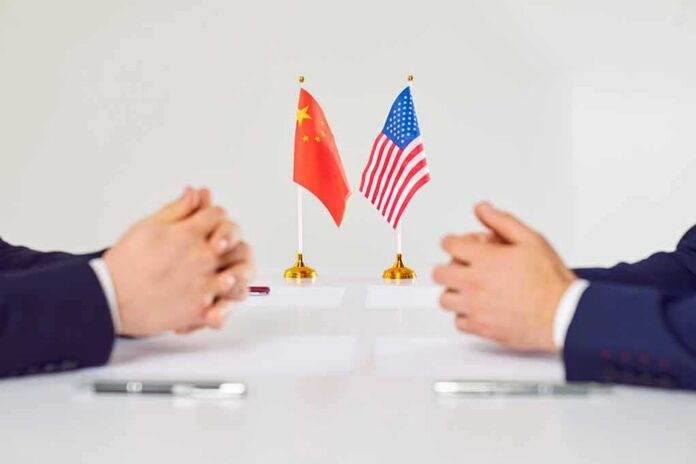
President Trump, China’s Xi, and Russia’s Putin will hold a first-ever three-way meeting in China to talk nuclear weapons cuts, the White House says.
Story Snapshot
- The White House confirmed Trump, Xi, and Putin will meet during APEC in Shenzhen.
- Nuclear weapons reduction and non-proliferation will be on the agenda.
- Officials signaled expectations for symbolism and agenda-setting, not a fast treaty.
- China’s far smaller arsenal complicates three-way arms control talks.
White House Confirms Unprecedented Trilateral Summit
White House officials said President Trump will meet with Chinese President Xi Jinping and Russian President Vladimir Putin next week in Shenzhen, on the sidelines of the Asia-Pacific Economic Cooperation summit. The spokesperson said Trump plans to discuss nuclear weapons reduction during the meeting. This will be the first leader-level session bringing together the heads of the three largest nuclear powers at one table. The timing places the summit at the end of Trump’s China trip.
News outlets reported the sit-down will occur Thursday in Shenzhen, aligning with the summit schedule. Coverage described it as a historic first, set against a tense global backdrop and active regional conflicts. Prior remarks from Trump previewed his interest in a three-way talks format and a focus on denuclearization. Officials briefed reporters that the discussion would center on nuclear risks and non-proliferation, rather than other hot conflicts that usually dominate headlines.
What Will Likely Be Discussed—and What Will Not
White House guidance pointed to nuclear non-proliferation and possible directions for future arms limits. Reporting suggested Ukraine would not be the main theme, and aides did not predict a concrete deal. Instead, the session may aim to set a path and lower risks through leader-level signaling. That approach follows a pattern seen in past nuclear diplomacy, where early meetings frame issues and timelines before technical teams work on details over many months.
Veterans of arms control note that durable limits usually require careful definitions, shared data, and ways to check compliance. Earlier United States and Soviet, then Russian, agreements included notifications, satellite checks, and on-site inspections. These tools built enough trust to cut deployed warheads over time. A single summit can open a door, but it cannot replace the hard, technical work that follows. That history shapes what observers expect next if talks continue.
The Three-Power Challenge After Past Treaties Lapsed
The gathering comes after the last major nuclear treaty between Washington and Moscow expired, leaving the two largest arsenals without caps. That shift removed long-standing guardrails and increased calls for new limits. Analysts say a three-way process is tougher than two-party talks because each country has different stockpiles, strategies, and red lines. That is why many expect careful steps, not sweeping cuts, from an initial meeting like this one.
China’s known stockpile is far smaller than those of the United States and Russia, according to public estimates. That gap explains Beijing’s reluctance to join deals that mirror past United States–Russia frameworks built for much larger forces. Chinese officials have argued that any plan must reflect the imbalance in numbers and roles. That reality makes a single set of rules hard to design and may push talks toward phased or tailored measures if they advance.
Why This Meeting Matters for Americans
The three leaders control the biggest nuclear forces on Earth. Any step that lowers miscalculation risks matters for everyone. People across the political spectrum worry about great-power standoffs, wars that spill beyond borders, and leaders who seem to play power games while families at home face rising costs and insecurity. A meeting that reduces nuclear danger, even a little, serves a basic promise of government: protect the public from the worst threats.
🇺🇸🇷🇺🇨🇳Trump announced a meeting with Putin and Xi Jinping as soon as next Thursday
The meeting will take place on November 19 in Shenzhen, on the sidelines of the APEC summit, the U.S. president said.
▪️Sources say the summit is expected to address controls on the use of… pic.twitter.com/i1BL53nQEq
— Ignorance, the root and stem of all evil (@ivan_8848) November 14, 2026
Still, a first meeting is only a start. Past deals took long, detailed talks that locked in definitions, data, and checks. If this summit launches that process, the value could be real even without a same-day breakthrough. If it does not, the world returns to a riskier status quo. Voters should watch for follow-on working groups, timelines, and verification ideas. Those signals will show whether leaders mean business or just staged a photo moment.
Sources:
reuters.com, news.bloomberglaw.com, ibtimes.sg, afsa.org, osti.gov
© primechronicle.org 2026. All rights reserved.