

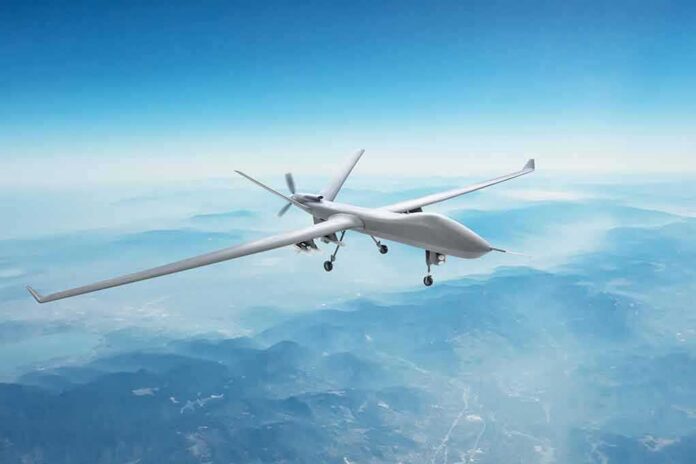
The Pentagon’s quiet new drone deal with Ukraine edges America’s war-fighting technology — and its defense industry — deeper into a global battlefield run by unmanned machines.
Story Snapshot
- Ukraine and the United States signed a first-of-its-kind statement of intent to send Ukrainian drones to America for military testing and evaluation.
- The arrangement ties into the Pentagon’s “Drone Dominance” program, with six Ukrainian firms reportedly cleared to export about 100 drones each.
- President Volodymyr Zelenskyy says American forces are already testing Ukrainian aerial and sea drones and giving “very positive feedback.”
- The deal is not yet a full weapons-buying contract, but it opens the door to joint production of combat drones on U.S. soil.
What Exactly Did Ukraine and the Pentagon Agree To?
Ukraine and the United States have signed a formal statement of intent that creates a framework for drone cooperation between the two governments. This document is described as the first of its kind, focused on letting Ukrainian ground, air, and sea drones be exported to the United States for military testing and evaluation, not for direct battlefield use by U.S. troops yet. Reporters who saw or were briefed on the statement say it was signed by officials in Washington and Kyiv and that one official called the deal “sealed,” meaning both sides consider it real, not just talk. The statement of intent itself is not a purchase contract, but it sets the rules for how the Pentagon can ask for specific Ukrainian drone models, test them, and use the results to shape future buying decisions.
How Many Drones, Which Companies, and What Is the Drone Dominance Program?
Media reports that build on Reuters and Radio Free Europe say six Ukrainian companies have received permission to export about 100 drones each to the United States. That adds up to roughly 600 drones feeding into a Pentagon effort known as the Drone Dominance program, which aims to boost small combat drone numbers and U.S. production capacity between 2026 and 2027. This program reflects a major shift: the Pentagon, long slow and cautious on new tech, is now rushing to learn from Ukraine’s brutal trial-and-error drone war against Russia. The idea is that Ukrainian battlefield-tested designs can help American planners avoid wasting money on unproven gadgets and instead focus on what already works under fire.
Testing Already Underway, But Full Deal Still Stalled
Ukrainian President Volodymyr Zelenskyy recently said the United States is already testing Ukrainian aerial and maritime drones and has given “very positive feedback.” He described signed documents that allow American forces to receive “various types of systems” from Ukraine specifically for testing, and he listed air drones, sea drones, and other tech now in U.S. hands. At the same time, Zelenskyy made clear that the huge “drone deal” he has valued at tens of billions of dollars, including a large joint production venture, remains unsigned and awaits political sign-off in Washington. This matches earlier reporting that a draft memorandum between the State Department and Ukraine’s ambassador exists and is being reviewed, but has not yet become a binding procurement contract with fixed orders and money attached.
Why Is Washington Turning to Ukrainian Drones Now?
U.S. interest in Ukrainian drones has grown as wars with Russia and Iran have exposed gaps in American defenses against swarms of cheap, deadly unmanned systems. Analysis of the Russia-Ukraine war shows Ukraine ramped up drone production from hundreds of thousands to millions in just a few years, using fast, flexible buying rules and close ties between its military and civilian tech sector. That success has made Ukraine a testing lab for modern warfare, where small teams with low-cost drones can damage big, expensive weapons and bases. Facing this reality, U.S. officials are now looking at Ukrainian drones and anti-drone tools as a shortcut to improve American capabilities without waiting years for traditional defense contractors.
Where Do Things Still Look Murky or Troubling?
Not all parts of the story are clear. Some reports stress that the main U.S.-Ukraine drone agreement is still only a draft framework being reviewed by different agencies and lacks firm approval from top Pentagon and White House leaders. A Pentagon spokesperson has already pushed back on at least one reported detail, calling the claim that a named official signed the deal “false,” which shows how messy early reporting on secret defense talks can be. There is also no full public text of the Drone Dominance program or the signed statement, so citizens must rely on leaks and selective quotes rather than see the fine print about costs, risks, and oversight.
What This Means for Ordinary Americans and the “System” They Distrust
For many Americans on both the right and the left, this deal taps into deep worries about how the defense system really works. The Pentagon is reaching abroad for fast, battle-tested drones while domestic factories and workers struggle with slow contracts and red tape, which feels like another example of Washington solving problems everywhere but at home. The plan to bring Ukrainian designs into U.S. testing and maybe U.S. production could create jobs, but it also strengthens a defense industry that many see as too cozy with politicians and lobbyists already. Add in the fact that key documents remain secret, sources are anonymous, and the biggest decisions hinge on internal debates among elites, and the picture matches a familiar pattern: major national-security choices made far from public view, with regular citizens told only what officials choose to share.
Ukraine agrees to export drones to US for Pentagon plan, source says
Ukraine has agreed to export drones to the United States to participate in the Pentagon's Drone Dominance programme, a source familiar with the matter told Reuters on Wednesday.
The agreement comes as Kyiv…
— Alex 🇺🇸 (@A_L_E_X_V_E_G_A) July 22, 2026
Sources:
realcleardefense.com, facebook.com, upday.com, politico.com, wmbdradio.com, fakti.bg, militarytimes.com, investing.com, youtube.com, reuters.com
© primechronicle.org 2026. All rights reserved.