
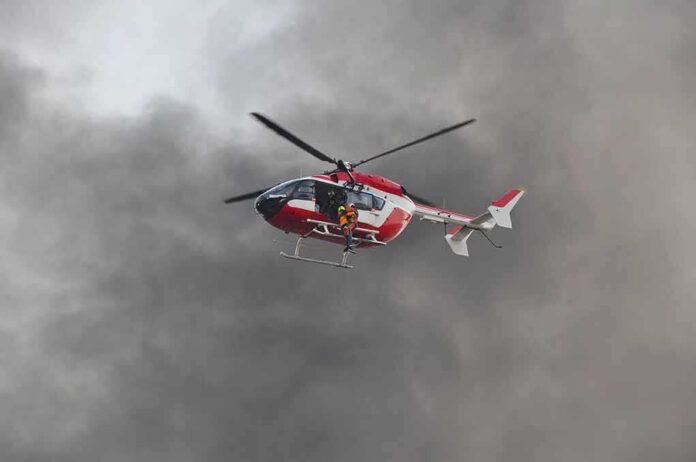
A firefighting helicopter crashed near Richfield while battling Utah’s Widemouth 2 Fire, and officials still had not confirmed the status of the two people on board.
Quick Take
- The Federal Aviation Administration confirmed a Sikorsky S-64 helicopter crashed near Richfield at about 10 a.m. while responding to the fire.
- Multiple reports said two people were aboard, but their condition was still unknown in the first wave of coverage.
- Officials said fire behavior and steep terrain made the crash scene hard to reach.
- The National Transportation Safety Board and the Federal Aviation Administration were set to investigate the crash once the site was reachable.
Crash Scene Locked Down by Fire Conditions
The crash happened in the middle of a fast-moving wildfire response, not in a calm recovery zone. Federal Aviation Administration reporting said the helicopter went down near Richfield while helping fight the Widemouth 2 Fire. Local officials said fire conditions did not allow access to the site, which delayed a close look at what happened and left the early record dependent on official briefings.
That limited access matters because it slows both rescue and verification. Sevier County officials said responders were still working out when it was safe to enter. The lack of immediate access also helps explain why early reports focused on the crash itself, not the crew’s condition or the cause. In a disaster story, that kind of gap can feed rumors fast, especially when social media moves faster than field crews.
Two Aboard, but Their Condition Was Still Unknown
News outlets closely matched on one key point: two people were aboard the helicopter. The Federal Aviation Administration said that in contemporaneous reports from KUTV, PBS, and other outlets. Even so, those same reports said officials did not yet know whether the crew survived. One Facebook post and other social messages moved ahead of the verified record and repeated fatality claims before official confirmation.
That tension is common in breaking disaster coverage. The public wants answers right away, but officials often wait until families are notified and the site can be reached safely. In this case, early coverage made clear that the crash was real, but the human cost was still unresolved. That leaves room for confusion, especially when some posts frame speculation as fact before investigators or local authorities can speak clearly.
Investigation, Operations, and the Bigger Wildfire Picture
The National Transportation Safety Board was identified as the lead investigator, with the Federal Aviation Administration also expected to review the crash. Reporters said the helicopter was one of several aircraft assigned to the fire, and the blaze itself had already grown large by the time of the crash. KUTV and PBS both described a wide, active fire scene, which shows how much pressure crews were under when the accident happened.
A heavy-lift helicopter carrying two people crashed while battling a large wildfire in Utah, while a bulldozer operator was killed in a separate wildfire in Oregon, officials said.
The Sikorsky S-64 helicopter went down near Richfield, Utah, while working on a lightning-sparked… pic.twitter.com/7qqb5mY2EH
— India Today Global (@ITGGlobal) August 8, 2026
Officials also said air operations were not broadly shut down after the crash, even though one helicopter was lost. That detail points to the hard tradeoffs built into wildfire response: crews keep working while one part of the operation is under investigation, because the fire still threatens homes, land, and lives. The larger picture is familiar to many Americans. When a system is stretched this thin, even basic facts can take hours to settle.
Sources:
nypost.com, timesnownews.com, wfaa.com, kutv.com, facebook.com, nampa.org, youtube.com
© primechronicle.org 2026. All rights reserved.