
Three people are dead, an illegal truck driver got less than five years, and both sides now see a justice system that looks easier on government mistakes than on ordinary families.
Story Snapshot
- Three people were killed and four injured in a fiery eight-vehicle crash on Interstate 10 in Ontario, California.
- Truck driver Jashanpreet Singh pleaded guilty to three counts of felony vehicular manslaughter with gross negligence.
- A California judge sentenced him to four years and eight months in state prison, sparking outrage over lenient punishment and system failure.
- Singh is an illegal immigrant who still held a California commercial driver’s license, raising questions about state and federal oversight.
A deadly crash that shook a California freeway
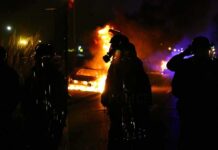
On an October 2025 morning, 21-year-old truck driver Jashanpreet Singh slammed his semi-truck into backed-up traffic on the westbound Interstate 10 Freeway in Ontario, California. The crash involved eight vehicles, including three other semi-trucks, two pickup trucks, and two cars. Three people were killed and four others were injured, including Singh and a roadside mechanic changing a tire on the shoulder. The San Bernardino County District Attorney called the case one of grossly negligent driving that turned a busy freeway into a deadly pile of twisted metal and flames.
Prosecutors charged Singh with three counts of vehicular manslaughter with gross negligence and one count of driving under the influence causing injury, all linked to the same violent chain reaction crash. Police at first arrested Singh at the scene on suspicion of driving under the influence, which fit early fears that drugs or alcohol were behind the destruction. Later toxicology reports, however, showed no illegal substances in his blood at the time of testing, and the driving under the influence charge was dropped. That left gross negligence, not intoxication, as the core of the criminal case and set the stage for a lower sentencing range than many grieving residents expected.
How the case moved from trial threat to short prison term
Singh originally pleaded not guilty, and local coverage highlighted the risk of a long sentence if a jury found he acted with extreme disregard for human life. In June 2026, he changed his plea to guilty on three counts of felony vehicular manslaughter with gross negligence, formally admitting criminal responsibility for the three deaths. Under California law, gross vehicular manslaughter without driving under the influence typically carries a range of two, four, or six years in state prison. Singh’s eventual term of four years and eight months sits in the middle of that range, not at the minimum, but far below what some people believe such a crash deserves. That gap between legal norms and public anger is driving much of the present outrage.
At sentencing in Rancho Cucamonga, the judge weighed several factors that usually push punishment down instead of up. Reports say the court considered Singh’s young age, only 21 at the time of the crash, his lack of prior criminal or violent history, and the absence of strong evidence that he was distracted by a cellphone. One victim’s family delivered a statement, but the families of Clarence and Lisa Nielsen chose not to speak publicly about the sentence. Without their voices on the record, critics have fewer direct quotes to show that all families wanted a much harsher outcome, even though many neighbors plainly feel the system failed them.
Immigration status, licensing, and the “system failure” worry
Beyond the crash itself, many Americans are focused on how Singh was on that freeway at all. NBC4 and other outlets report that Singh entered the United States in 2022 and is in the country illegally, yet he still held a California commercial driver’s license. Federal officials from the Department of Transportation have accused California of breaking federal rules on commercial license eligibility for some non-citizens, while Governor Gavin Newsom argues that the federal government controls who can qualify. This tug-of-war leaves regular people asking how someone the federal government wants to deport ended up behind the wheel of a massive truck on a crowded freeway. For both conservatives and liberals who distrust the “deep state,” this looks less like a single mistake and more like a system that does not talk to itself.
California law also limits how immigration status can be used in court, especially in civil wrongful death and injury cases. Evidence rules aim to keep juries focused on what happened on the road, not on where a driver was born or how he entered the country. That protection makes sense to many who fear bias. Still, in this case, the idea that a person wanted by federal immigration officers could receive a mid-range sentence for a crash that killed three people feeds an existing belief that government layers protect themselves while failing ordinary citizens. People on the right see open-border carelessness; people on the left see a transportation and labor system that treats truck drivers and highway workers as expendable.
Why the sentence feels light, and why the anger is bigger than one judge
Critics point out that other truck drivers in different states have received decades in prison for deadly crashes, which makes Singh’s four-year-eight-month term look small by comparison. At the same time, California’s record shows many vehicular manslaughter sentences that fall below the maximum when the driver was not drunk, had no record, and pleaded guilty. That pattern suggests the judge here was following standard practice, not inventing a special break. Still, there is no public sentencing memo or full transcript explaining exactly how the judge weighed each factor, so people are left to fill in the blanks.
Outlets like The Gateway Pundit frame the case as proof of partisan bias, calling the judge a Democrat and tying the sentence to national fights over illegal immigration and crime. Yet there is no court record that clearly links party affiliation to the ruling itself. That gap has not stopped the story from spreading as another example, for both sides, of a justice and regulatory system that feels distant, confusing, and unaccountable. Whether a reader is more angry about illegal immigration or corporate trucking safety, the common thread is distrust: three lives were lost, government agencies disagreed about who should be allowed to drive, and in the end, the person at the center will likely be free before the families stop reliving the moment their loved ones died.
Sources:
thegatewaypundit.com, facebook.com, abc7.com, youtube.com, da.sbcounty.gov, dailybulletin.com, abc7chicago.com, justice.gov, indiatoday.in, joelbailey.com, sallymorinlaw.com
© primechronicle.org 2026. All rights reserved.