

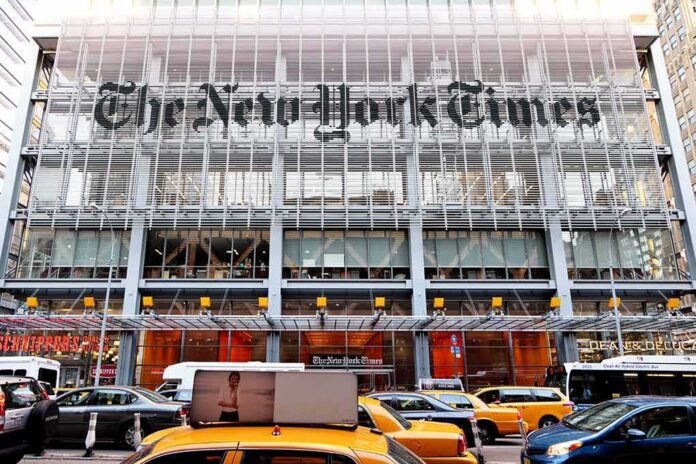
The New York Times has put AIPAC on the defensive by describing it as a “hard-right” pro-Israel group, a label that lands at a moment when the lobby’s grip on Democratic politics is visibly weakening.
Quick Take
- AIPAC is facing sharper public backlash as more Democrats move away from taking its money and backing its agenda.
- The New York Times has reported that the group has become “toxic” in some Democratic circles.
- Reporting also shows AIPAC still spends heavily in competitive Democratic primaries, even as it funds candidates in both parties.
- The “hard-right” label has drawn attention because it clashes with AIPAC’s long image as a bipartisan Washington player.
Why the Label Mattered
The New York Times framing stood out because AIPAC has long described itself as a bipartisan defender of the U.S.-Israel relationship. The paper has also reported that the group’s tactics have become more aggressive and have alienated some Democrats, while candidates have begun distancing themselves from it. That shift matters in Washington because AIPAC’s power has always rested on access, money, and the claim that it can work across party lines.
What has changed is the political terrain around Israel after the Gaza war. The Times reported that Democratic voters have increasingly pulled away from supporting Israel since the conflict began, and that trend has fed new pressure on lawmakers who once accepted AIPAC support without much public cost. In that setting, the organization is no longer just a donor network. It has become a test case for how much foreign-policy loyalty American candidates can demand from their own party.
Money, Primaries, and Democratic Blowback
AIPAC’s spending pattern helps explain the backlash. Reporting shows the group spent heavily in 2024 and aimed much of its firepower at Democratic primaries, where it backed moderates over critics of Israel. That approach gave opponents an easy line of attack: they cast AIPAC not as a neutral lobby, but as an outside force shaping Democratic contests from the right edge of the pro-Israel world. The result is a fight over influence, not just a fight over language.
Fox News and other conservative voices seized on the Times description, arguing that the “hard-right” label itself was the story. But the deeper fact is simpler: AIPAC’s political brand has changed fast. The Times described it as “toxic” inside parts of the Democratic coalition, and that warning sign is backed by public reports of candidates refusing its money and activists challenging incumbents who accept its support. Even without a formal poll, the evidence points to clear erosion.
What the Debate Says About U.S. Politics
The dispute over one phrase also reflects a broader breakdown in trust. AIPAC’s critics say its close ties to Israel’s right-wing leadership and its pressure on dissenting Democrats show how foreign policy, campaign money, and party discipline now overlap in ways many voters dislike. Supporters answer that the group is still a mainstream pro-Israel lobby and that its bipartisan giving proves the point. Both views can be true at once: AIPAC remains powerful, but its reputation is clearly under strain.
The larger lesson is not about one headline. It is about how fast old labels can collapse when public anger grows. AIPAC once benefited from being seen as a safe, bipartisan fixture in Washington. Now it faces a harsher public mood, a more skeptical Democratic base, and rising questions about whether the old rules still protect elite institutions that have long shaped policy from behind the scenes. That tension is now part of the story, not a side note.
“The tide is changing,” Representative Thomas Massie declared last night after his attempt to zero out Israel aid failed 104-314. What made it a shift in tide wasn’t the outcome—a doomed show vote from the start—but the Democratic split: 103 Democrats voted yes, 98 voted no, and…
— Amit Segal (@AmitSegal) July 16, 2026
For readers, the key point is that this is no longer just a media fight over wording. It is a sign that one of Washington’s best-known lobbying groups is losing its old shield of respectability, especially among Democrats who once treated its support as routine. Whether the “hard-right” label sticks or not, the political damage behind it is already real, and it reflects a broader distrust of entrenched power that cuts across the electorate.
Sources:
foxnews.com, nytimes.com, washingtonexaminer.com
© primechronicle.org 2026. All rights reserved.