
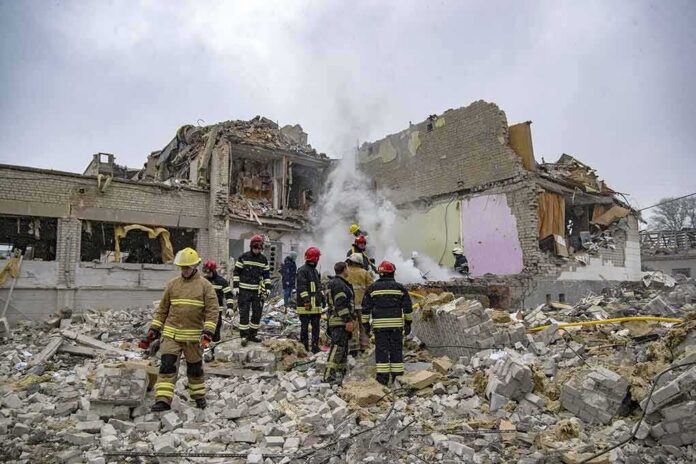
Russia says it struck defense targets near Kyiv, while Ukrainian officials say a missile hit a site hosting a defense-industry event that left at least 10 people dead.
Story Snapshot
- Ukrainian officials and industry reps say a missile hit a Kyiv-region defense event, killing about 10 and injuring many more.
- Russia says its “massive” strikes aimed at defense-industry facilities and military sites around Kyiv.
- Reports differ on the exact venue and casualty counts, and independent verification remains limited.
- Both sides warned of more strikes, keeping the risk to civilians and industry high.
What Both Sides Agree On: A Deadly Strike Near Kyiv
Ukrainian officials and industry representatives said a Russian ballistic missile hit a site in the Kyiv region where a defense event was underway, killing about 10 people and injuring close to 100. Local authorities reported emergency crews at the scene and ongoing rescue work. The Kyiv Independent reported similar figures, describing the gathering as an arms exhibition attended by defense-industry personnel. These claims place defense-related activity and casualties at the same location and time.
Russia said its forces carried out a large, coordinated attack using long-range precision weapons and drones against defense-industry facilities and military-linked sites in and around Kyiv. Moscow has made similar claims before, saying strikes focus on military production and airfields. These statements fit a pattern in which Russia frames attacks as hits on military or dual-use targets, often after warning that “systematic” strikes would continue. The claims about target type, however, remain difficult to confirm quickly.
What Is Known, What Is Disputed
Key facts remain unsettled. Reports differ on the exact location, described as Kyiv Oblast, Bucha district, or a village near Kyiv, which makes precise mapping hard. Casualty numbers also vary across outlets, with some stating at least 10 dead and around 100 injured, while others report lower or higher figures. Independent analysts have not yet published open, verified imagery or forensic studies to confirm whether the site was a formal exhibition, a training ground, or a mixed-use defense facility.
Even with gaps, several outlets report that defense-industry representatives were present when the strike occurred, which supports the claim of a defense-related event at the site. At the same time, Russia’s public line about targeting defense infrastructure matches its earlier statements and warnings about repeated, precision strikes against military production in Kyiv and its region. This clash of narratives—military intent versus civilian harm—has marked the war for years and often outpaces independent verification.
Why This Matters to Readers at Home
Events like this show how modern war blurs lines between civilian life and military work. Defense sites can sit near homes or roads. People who are not in uniform may work on weapons or logistics. When missiles hit, the public often hears two messages: one about military targets, and one about civilian losses. Without fast, trusted proof, citizens are asked to accept claims on faith, which feeds anger at leaders, agencies, and media on all sides.
Anton Gerashchenko
This video speaks volumes abut us Ukrainians. It was filmed in Lukianivka district in Kyiv that is under Russian attacks often.
Just a few hours after last night's Russian strike, the market and people there resumed working.
My heart breaks from what our… pic.twitter.com/m5TMXUKZr9
— Gianl1974 (@Gianl1974) July 21, 2026
For Americans who feel Washington’s institutions no longer tell the full story, this is familiar. Governments shape messages to defend policy and avoid blame. Media race to report, often with limited access. The result is confusion that leaves families unsure whom to trust. That confusion has costs: it can weaken public support, cloud aid debates, and distract from the real task of protecting innocent people while holding true military targets accountable under the laws of war.
What to Watch Next
Watch for satellite analysis, geolocated images, and official incident reports that can confirm the site’s precise use and layout. Look for a single, documented casualty ledger and named witness accounts. Expect Russia to keep saying it hit defense infrastructure, and Ukraine to press the case that civilians and industry workers were killed at a legitimate gathering. Also track whether new warnings signal more large strikes. Reuters has reported repeated alerts about major attacks on Kyiv.
In the near term, policymakers will weigh air-defense gaps, supply needs, and risk to foreign personnel at defense events. Citizens should ask simple, fair questions: What was at the site? Who approved the event and security plan? What evidence proves the target set? Clear answers, with documents and imagery, matter more than talking points. Until then, claims on both sides should be treated as claims, not conclusions, and the priority should be saving lives and reducing harm.
Sources:
bloomberg.com, cfr.org, hurriyetdailynews.com, abcnews.com
© primechronicle.org 2026. All rights reserved.