
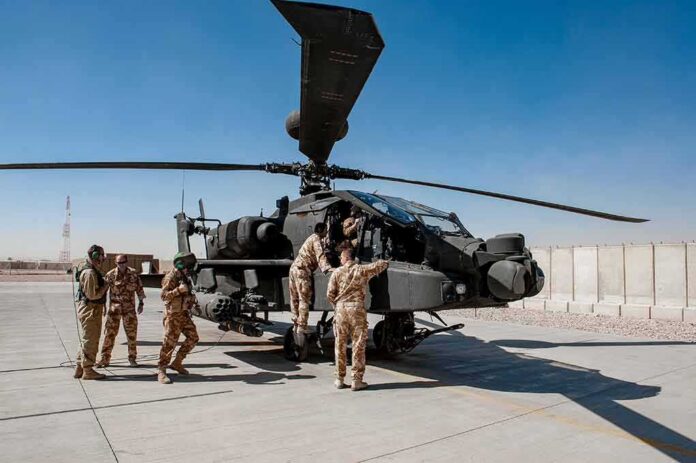
Two young American soldiers were killed when Iranian missiles punched through defenses at a Jordan air base, and the U.S. answer was yet another wave of war that still does not feel like it is making America safer.
Story Snapshot
- Two U.S. soldiers, 1st Lt. Tyler Feehan and Pvt. Isabella Gonzales, were killed in an Iranian strike on Muwaffaq Salti Air Base in Jordan, with one service member still missing.
- Iran’s Islamic Revolutionary Guard Corps claimed credit for the attack, saying it targeted U.S. aircraft and facilities at the Jordan base.
- U.S. Central Command launched new airstrikes on Iranian military targets after the attack, directed by President Trump.
- The Jordan strike is part of a wider pattern of missile and drone attacks and rising U.S. casualties in the months‑long war with Iran.
Who These Fallen Soldiers Were and What Happened in Jordan
The Pentagon says the two soldiers killed in Jordan were 1st Lt. Tyler James Feehan, 25, from Hawaii, and Pvt. Isabella Gonzales, 19, from Texas. They died in separate explosions tied to the same Iranian attack on Muwaffaq Salti Air Base near Azraq, a key hub for U.S. air operations in Jordan. U.S. Central Command reports another service member is still missing, and unidentified remains have been recovered at the site, awaiting confirmation. This strike hit housing and work areas, not just empty desert.
U.S. Central Command says Iranian ballistic missiles and drones were launched on July 17 against the Jordan base, and U.S. and partner forces tried to defend the site. Video shared by news outlets appears to show missiles hitting the base, followed by fire and smoke rising from impact points. Iran’s Islamic Revolutionary Guard Corps claimed it was aiming at U.S. military aircraft and said it damaged refueling planes and fighter jets. Satellite images also show destroyed hangars and scattered debris, suggesting serious damage to critical facilities.
How the U.S. Responded and Why the War Keeps Growing
Within a day of the Jordan attack, U.S. Central Command announced new airstrikes against Iran ordered by President Trump. Military statements say these strikes hit Iranian command centers, air defense sites, missile and drone launch positions, and coastal surveillance systems. The goal, according to U.S. officials, is to punish the Islamic Revolutionary Guard Corps units that attacked American troops and weaken Iran’s ability to threaten shipping in the Strait of Hormuz. Iran, in turn, reports dozens killed and hundreds wounded from these U.S. strikes.
These latest deaths in Jordan come on top of growing American losses since U.S. and Israeli operations against Iran began in late February. News reports count at least 17 U.S. service members killed in the war so far, including six who died in a drone strike on a poorly protected tactical operations center in Kuwait. Casualty trackers note higher numbers when they add later incidents, raising questions about how fully the Pentagon shares information. For many Americans, this pattern looks like a long, grinding conflict with no clear end or victory, only more dead soldiers and damaged bases.
Why This Hits Nerves Across the Political Spectrum
This attack in Jordan is not the first time Iran or its allies have gone after U.S. troops in the region. In January 2024, an Iranian‑backed militia used a drone to kill three American soldiers at a small outpost called Tower 22 in northeast Jordan. Now, Iran’s own forces are openly firing missiles at larger bases and claiming credit. That shift from proxy attacks to direct strikes worries many who already think Washington has left troops exposed with thin defenses and confusing missions.
For conservatives, this incident feeds frustration that decades of Middle East wars have cost lives without securing the border, fixing inflation, or lowering energy prices at home. For liberals, it underscores fears that “America First” still means America in endless foreign fights while social needs at home are sidelined. Both sides see the same pattern: decisions made by distant leaders, rising body counts, and no honest plan that shows how this war helps ordinary Americans or protects their families.
Deep State Concerns, Base Vulnerabilities, and What Comes Next
Imagery from earlier strikes in Kuwait showed U.S. soldiers working in a command center with little protection from drones. Now reports from Jordan describe missiles hitting troop housing units. When bases are this vulnerable, people on both the right and left ask why the Pentagon can spend billions on complex systems yet still fail to shield young service members from well‑known threats. That gap feeds anger at what many call the “deep state” — a permanent security class that seems more focused on its own budgets and influence than on common‑sense safety.
American leaders insist that more strikes on Iran will “degrade” its military and send a strong message. But Iran keeps firing back at U.S. sites in Jordan, Kuwait, Bahrain, and beyond. Each cycle of attack and response raises the stakes, with nuclear facilities, regional allies, and global trade lanes in the background. Citizens who already feel ignored by Washington now watch their sons and daughters sent into a war where missiles slip past shields and the endgame is unclear. That is the deeper fear this Jordan attack brings into sharp focus.
Sources:
cnn.com, nytimes.com, washingtonpost.com, fox2detroit.com, en.wikipedia.org, reuters.com, bbc.com, war.gov, ndtv.com, pbs.org, forbes.com
© primechronicle.org 2026. All rights reserved.