

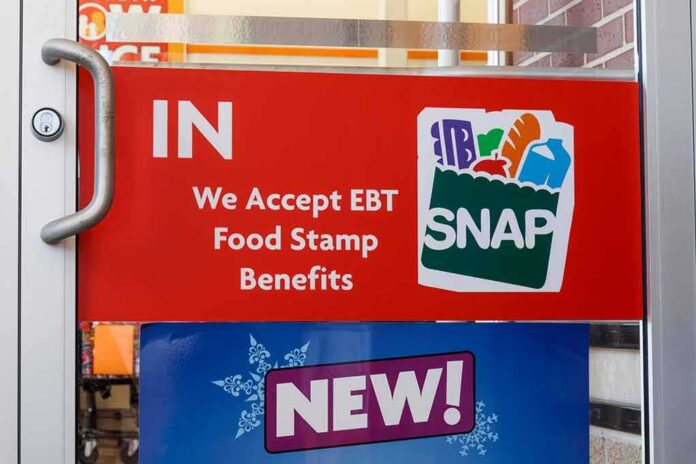
A sweeping federal rule change expanded who must work to keep food aid, and millions fewer people are on SNAP as a result.
Story Snapshot
- Federal guidance shows the law broadened SNAP’s time-limit work rule to ages 18–64.
- Covered adults must average 20 hours of work or approved activities weekly or face a three-month limit.
- Exceptions were removed or narrowed for several vulnerable groups, increasing exposure to the rule.
- Maine added compliance steps like job registration that can trigger case closures.
What changed in federal SNAP rules and who it now covers
United States Department of Agriculture guidance says the One Big Beautiful Bill Act expanded the SNAP time-limit population from ages 18–54 to ages 18–64. That change exposes older working-age adults to the rule for the first time in decades. The agency also explains that some exceptions were removed or narrowed, which increases the number of people who must comply. These steps create a clear pathway for lower enrollment that is tied to eligibility rules, not only to economic gains.
United States Department of Agriculture materials describe the mechanics of the time limit. Covered adults must work or be in an approved work program for at least 20 hours per week, averaged to 80 hours per month. People who do not meet that standard can only get three months of food help in a 36‑month window. Those months are tracked, and the limit resets only after the 36‑month period ends. This is separate from SNAP’s general work rules for other adults.
Why opponents say the changes hit vulnerable groups
United States Department of Agriculture implementation guidance states the law removed or narrowed exceptions for people who are homeless, veterans, and young adults who aged out of foster care. It also limited the caregiver exception to parents with children under 14. That means more people in hard situations must now meet monthly work hours to keep aid. Critics argue this turns a safety net into a compliance test that some cannot pass in unstable lives.
NPR reported that new requirements also apply to parents of teens ages 14–17 and adults ages 55–64, and it cited a Congressional Budget Office estimate that work-rule changes would reduce average participation by about 2.4 million people over 2025–2034. Reporting by Marketplace quoted a policy expert saying more than 4 million people left SNAP between mid‑2025 and early 2026. These figures back claims that the policy change, by design, lowers caseloads, even if need persists.
How Maine implemented the rules and what that means for families
Maine’s Department of Health and Human Services lists general work requirements like registering for work, responding to job referrals, and not quitting a job without good cause. The state also notes that people who work 30 hours a week or earn the equivalent are exempt from some rules. These steps layer on top of the federal time limit, so missing a step can still put benefits at risk even if a person is working some hours.
A Maine Secretary of State rule requires covered people ages 16–59 in some households to create and maintain an active Maine JobLink account. The order also sets workfare rules and hour caps. These administrative checkpoints can cause exits when notices are missed, accounts lapse, or documents are late, regardless of ongoing hardship. The rule shows how compliance systems, not only jobs, shape who keeps or loses food help during implementation.
Competing claims about what the decline means for the country
An Associated Press report said SNAP enrollment fell from 42.2 million in May 2025 to 36.6 million in May 2026, a steep one‑year drop. Researchers and advocates say the expanded work rules, narrowed exceptions, and added steps explain much of the decline. Federal guidance confirms those changes. What the sources do not show is how many exits came from better jobs versus missed paperwork or barriers to meeting steady weekly hours.
Both parties share a core worry: big systems are serving themselves first. Supporters of tighter rules say taxpayers deserve clear standards and that SNAP should encourage work. Opponents say Washington moved the goalposts for seniors, veterans, and homeless people while food prices stay high. The record proves the rules got stricter and the covered group grew. The record does not yet prove why each person left or whether their food security improved afterward.
What to watch next to cut through the noise
State and federal agencies could release monthly caseload data that show exits by age, exemption status, work hours, and reasons for closure. They could also link exits to wage records to learn who found stable work and who returned to SNAP within months. Without that, the drop will look to many like a choice by elites to trim rolls, not a path to self‑reliance. Clear data would let the public judge if the policy meets its goals.
Sources:
thegatewaypundit.com, fna.usda.gov, usda.gov, maine.gov
© primechronicle.org 2026. All rights reserved.