
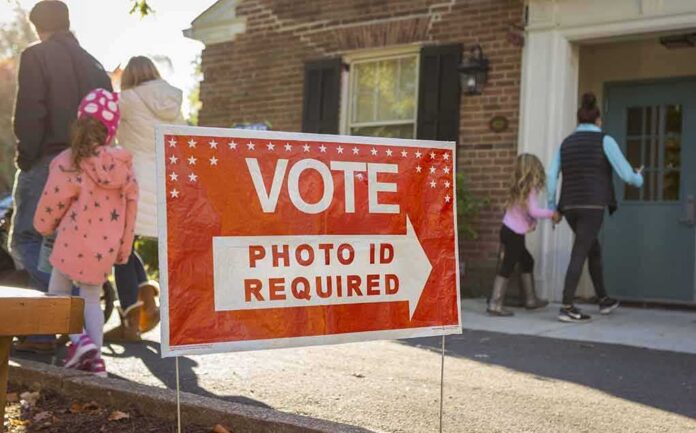
California’s fight over voter ID has turned into a battle over whether state officials are shaping the rules—or shaping what voters are told about those rules.
Story Snapshot
- California’s voter ID initiative, Proposition 39, would add ID and citizenship checks to state elections.
- Top Democratic leaders are organizing a major campaign to defeat the measure and protect broad ballot access.
- Attorney General Rob Bonta changed the official ballot wording, triggering accusations that Democrats are trying to mislead voters.
- Supporters say the fight shows how political insiders can tilt the playing field even after citizens qualify a measure.
What Proposition 39 Would Do to California Elections
Proposition 39 is a proposed amendment to the California Constitution that would require voters to use a government-issued identification card for in-person voting and a government ID number for voting by mail. Under the measure, mail voters would write the last four digits of a government ID, such as a driver license, and election officials would have to verify each ballot’s registration against state and county records. The plan also adds formal citizenship verification and tighter management of voter lists.
Supporters frame the initiative as an “election integrity” package they say most Americans already expect when voting. Republican Assemblymember Carl DeMaio, who led the signature drive, argues California’s current system is too loose and undermines trust, and he says the measure would require accurate voter rolls and make the state provide free voter ID cards so cost is not a barrier. Backers stress that only United States citizens could vote and that counties would have to report on citizenship checks and voter list maintenance.
How California Democrats Are Moving to Stop It
Democratic lawmakers in Sacramento had already blocked a similar voter ID plan in the legislature before the ballot initiative emerged. In 2025, Democrats on the State Assembly Elections Committee killed DeMaio’s bill, AB 25, after arguing it would restrict voting access, even as it proposed ID for in-person and mail voting and stricter list maintenance and ballot counting rules. After that vote, DeMaio promised to take the issue directly to voters through a citizen initiative, setting the stage for Proposition 39.
Once the initiative qualified, leading California Democrats launched an organized campaign to defeat it. A new anti–Proposition 39 committee is chaired by gubernatorial frontrunner Xavier Becerra and Assembly Speaker Robert Rivas, who will headline fundraising for the opposition. Major unions and advocacy groups, including Service Employees International Union California and the California Teachers Association, joined as early backers, and the campaign opened with about $2 million on hand to make the case that ID rules would disenfranchise lawful voters rather than fix a proven problem.
The Ballot Language Fight and Deep-State Suspicions
The fiercest clash so far is over the exact words voters will see on their ballots. After the initiative qualified, Attorney General Rob Bonta’s office rewrote the official title and summary in a way that changed the emphasis from “establishes additional voter identification and citizenship verification requirements” to “prohibits citizens from voting unless they present government-issued identification.” Supporters say this new wording paints the measure as a ban on voting instead of a security rule and will push casual voters to vote no without reading further.
Backers of Proposition 39 are now preparing to sue Bonta, arguing the revised language is false and designed to sway the election. In news interviews and online videos, they accuse state officials of “rigging” the contest by changing the description after more than a year of signature gathering under the earlier wording. DeMaio and other supporters call this “blatant manipulation” by political insiders and say it confirms many voters’ fears that the people running the system care more about keeping power than about honest debate.
Access vs. Integrity: Why Both Sides Feel Betrayed
Democrats and allied civil rights groups argue voter ID rules make it harder for poor, elderly, and minority voters to cast ballots, especially in a state that already has high vote-by-mail use. They point out that California does not have documented, widespread in-person voter fraud and say new ID checks could block thousands of legal votes to stop a tiny number of bad actors. For many on the left, they see voter ID not as a neutral safety measure but as part of a broader pattern of restrictions that deepen the gap between the politically powerful and ordinary citizens.
Supporters of Proposition 39 counter that almost every adult already uses ID for daily life and that free voter ID cards would protect anyone who lacks one. They argue that accurate voter lists and citizenship checks are basic safeguards, not partisan weapons, and say the strong pushback from state officials shows how the political class resists any outside effort to change the rules of the game. For conservative and many independent voters, the ballot language dispute feeds long-running worries about a “deep state” culture in which insiders adjust processes, wording, and timing to steer outcomes without ever openly admitting it.
What This Battle Signals About Power and Trust
The California voter ID fight speaks to a larger national trend: people across the spectrum doubt that government officials are putting fairness ahead of party interest. In this case, citizens gathered more than a million signatures to put a clear question on the ballot, only to watch elected leaders first block similar reforms in the legislature and then rewrite the measure’s official description. For many voters, that sequence feels less like healthy debate and more like a warning about how far those in power will go to keep control over the system itself.
Whether Proposition 39 passes or fails, the clash highlights a core problem in American democracy today. Voters keep hearing they are in charge, yet they see insiders shaping the language, framing the choices, and using legal and political tools to bend outcomes. California’s 2026 voter ID battle is not only about identification cards and citizenship checks. It is also a test of whether a citizen-led reform can get a fair hearing in a state where the governing class—left or right—often seems more focused on protecting its own grip on a deeply distrusted system.
Sources:
politico.com, latimes.com, calmatters.org, news.ballotpedia.org, foxnews.com, youtube.com, en.wikipedia.org, calmatters.digitaldemocracy.org
© primechronicle.org 2026. All rights reserved.